Andrew's Opera was previously published at http://www.redfernclinic.com/

17 July, 2006

Turandot in Sydney. Third time lucky (and unlucky!)

Sydney Opera House


Friday July 14 2006


RoleArtist
TurandotJennifer Wilson
LiuHye Seoung Kwon
CalafDongwon Shin
PingJohn Pringle
PangHenry Choo
PongKanen Breen
ConductorPatrick Summers
ProductionGraeme Murphy
DesignerKristian Fredrikson


Dear Colleagues,


After two less-than-satisfactory starts to the winter season (Lakmé and Clemenza di Tito) this Turandot was a night to remember for many reasons. It was a rainy, miserable night but all the finery was out for this show. Opera boss Adrian Collette announced the difficulties of replacing Dennis O'Neill at 3 days notice with Mr Shin flown in from America only the day before and singing without a rehearsal (and without a central stage prompter!). One wonders what would have happened if there was 3 hours notice of illness which occasionally occurs in the theatre.


This performance warmed up with each act improving on the last and a final triumph of voice, melody, movement, colour and drama of which I believe the composer would have been delighted.


Ms Wilson sang creditably. She had all the notes and was dramatic and exciting. Her 'In questa reggia' was a tour-de-force.


src="/opera/_images/turandot-poster1.jpg"
alt="Old poster of a long ago performance of Turandot" />

Mr Shin sang well but seemed under-powered initially, especially in the lower range. He rose to the occasion for 'Nessun dorma', ending on a magnificent high cadence which seemed to go on forever, loudly applauded, but without a musical break. His acting was slightly stiff but one must make allowances as he had never rehearsed this production. He sang the role at Santa Fe, along with many other major roles in minor houses in the US.


Ms Kwon made an excellent Liu, receiving a huge ovation at the end. The Korean ambassador had travelled from Canberra for the occasion with two of his citizens in the operatic lime light.


Mr Murphy's production is a masterpiece of colour and movement. He uses waving ribbons on sticks, extended hands, crowd 'rolls', shadows and many other 'tricks' to move the action along. His genius makes Ping Pang and Pong's scenes bearable and now, subtitles inform us that their 'chatter' could make a good episode of 'Yes Minister'. The opera chorus performed many synchronised stage feats in addition to their fine ensemble singing, as did the children's chorus.


Patrick Summers' conducting was animated, bringing tension, beauty and volume from members of the Opera and Ballet Orchestra. He got straight into the opera without delay or ceremony, receiving huge and appreciative applause at appropriate times. Summers was let down on a couple of minor occasions in the first and last acts with some brass glitches but with an excellent overall effect.


Jud Arthur was well cast this time as Timur, a role well within his substantial abilities. Henry Choo, Kanen Breen and John Pringle played 3 fine public servants while Shane Lowrencev opened the piece as an adequate town crier.


One hopes that the season will settle down, Mr O'Neill will regain his health and that as many Sydney-siders as possible will be able to witness this marvellous spectacle over the next month or so.


Comments by Andrew Byrne ..

The Melba - JC Williamson Tour of 1928

src="/opera/_images/smh1928-01.jpg"
alt="Front page Sydney Morning Herald 1928" />
Sydney Morning Herald
1928


Dear Colleagues,


When renovating my doctor's office I came upon some old Sydney newspapers.


Imagine my surprise in finding a series of opera reviews from 1928! This was a visit from an Italian company in collaboration with the Melba - JC Williamson Company. Some were printed the day after the performance, something which rarely happens these days. Also, reviews were anonymous then, yet these are opinionated, reflecting some interesting mores of the day. This was not a travelling company of 'unknowns'!


I am grateful for some details kindly provided by Bob Rideout of the USA:


I read with a great deal of interest Andrew Byrne's posting on the 1928 tour. I'll fill in some of the gaps for those who may be interested.


The roster included Giannina Arangi Lombardi, Tot Dal Monte, Hina Spani, Lina Scavizzi, Xenia Belmas, Giuseppina Zinetti, Angelo Minghetti, Francesco Merli, Enzo di Muro Lomanto, Apollo Granforte, Luigi Rossi Morelli, Fernando Autori, and the father of Loretta Corelli, Umberto Di Lelio. There were others but those were the names that you might easily know.


Nellie Melba sang with the company several times and made her final "final" operatic farewell on 2 October 1928 when she appeared at Adelaide in the last three acts of "La Boheme" with Mighetti, and closed the book with the "Salce" and "Ave Maria" from "Otello".


Xenia Belmas, a singer whose name will be known to some of you, was scheduled for a good number of performances, but somewhere along the way, Arangi Lombardi replaced her as Santuzza, and Belmas ended up singing a few concerts, divorced from the main company during the major portion of its stay. It was termed an "Italian Conspiracy" and caused a great deal of fuss, as did the replacement of John Brownlee, who had sung a few performances at the beginning of the season, with Apollo Granforte in "Pagliacci" and "Aida".


It was a very successful tour, but there was a lot of bad press about those and other intrigues. Dal Monte saw to it that fairly early on both Minghetti and Granforte were booted from her performances of "Rigoletto" and it was only near the end of the tour at Perth and Adelaide that they resumed their original assignments. Midway in the tour, Dal Monte and De Muro Lomanto were married at St, Mary's Cathedral in Sydney, and Arangi Lombardi, who was Dal Monte's maid of honour, sang an Ave Maria by Mercadante, 'exquisitely', said the press. At the service's conclusion, the wedding party gave the Fascist salute on the cathedral steps. Photographers had a "field day" and the story made headlines throughout the continent, and beyond.


I would imagine that the most important event on the tour was the Australian premiere of "Turandot" with Arangi and Merli. They received rave notices througout the season though the opera was treated somewhat less kindly.


In any case, the tour remains one of the most famous events in the history of opera "Down Under", or, "Opera for the Antipodes" as a wonderful reference work by Alison Gyger would have it.


Dates of Melba-Williamson season:


  • Turnadot

  • Fille was the second night of season (Mon 9th July) and review appeared in next day's paper.

  • next night was Thais.

  • Saturday 21st July night was Butterfly and review Mon 23 SMH.

  • Wednesday matinee? Trovatore Sat Aug 25th, review on 27th SMH.

  • Mon 27th was Hoffmann.

  • Tues 28th was Turandot.

  • Wed 29th August matinee Hoffmann; night: Manon Lescaut;

  • Thursday 30th 1928 Il Trovatore;

  • Friday 31st Rigoletto;

  • Sat 1 September matinee: Hoffmann; evening: L'Amore Dei Tre Re.


Monday 27th August


The cast of to-night's performance of "Tales of Hoffmann" at Her Majesty's Theatre includes Toti Dal Monte, Enzo de Muro Lomanto, Apollo Granforte, Aurora Rettore, Giuseppi Satariarno, and Luisa Banetti.


Coming performances


To-morrow night: "Turandot" will be presented. The management announced this as the last evening performance of the opera. On Wednesday afternoon, the opera is "Tales of Hoffmann;" on Wednesday night, "Manon. Lescaut;" on Thursday night, "Il Trovatore;" on Friday, "Rigoletto:" and on Saturday afternoon, "Tales of Hoffmann." Next Saturday night, Montemezzi's romantic opera, "L'Amore Dei Tre Re" will be presented for the first time in Sydney.


Newtown Majestic


"THE ROBBERS" The enterprise of Mr. Alfred Gordon Kalmikoff in producing for the first time in Sydney Schiller's great drama "The Robbers" at the Majestic Theatre, Newtown, was rewarded on Saturday by large audiences at both the matinee and evening performances. 'The Robbers' is a play so full of conflicting emotions that if cannot fail to have a strong appeal.


The plot, which centres around the family of the aged Count Maimilian, portrays the most different in character between the count's two sons, Charles and Francis. The latter wishing to get his elder brother disinherited, intercepts a letter which Charles has written to his father pleading for forgiveness, and reads a forged letter to the Count, making it appear that it was sent by an old friend giving instances of Charles' misdeeds. The count, broken-hearted, asks Francis to send a firm letter to Charles, but not to drive him to despair. Francis, on the contrary, writes that his father had cursed him, and does not want to see him any more: Charles, broken hearted, becomes the chief of a band of robbers.


The part of Francis was taken by Mr Kalmikoff, who in that difficult role found plenty of scope to show his versatility. His interpretation was perfect, and be invested the character with an impressive realism that *pleased* the audience. He achieved a <snip>


'Sepia' reviews of
Trovatore,
Fille du Regiment and
Butterfly were transcribed manually by Andrew Byrne. Note there were also several items under the heading: "Story of Tonight's Opera", including Thais, Tales of Hoffmann and others.


I am grateful for some details kindly provided by Bob Rideout of the USA.

13 July, 2006

Grand Opera - Il Trovatore - Old review from roaring 20's in Sydney town

"Il Trovatore" at Her Majesty's Theatre


Saturday 25th August 1928


"Il Trovatore" is the most tuneful of all Verdi's scores - some say the most tuneful in all Italian opera - but it is also the most thinly orchestrated. To modern ears, accustomed to the rich harmonic backgrounds and counter-melodies of Puccini and Wagner, or even to the later Verdi, exemplified in "Aida," the perfunctory vampings on the harp and broken chords on the violins pianissimo that accompany some of the stormy arias in "Il Trovatore" must perforce seem hopelessly insipid. In this opera Verdi has thrown almost all the responsibility for emotional effect upon the voices. The vocal line, pure and unadorned, must portray the feeling that lies behind the dialogue. That it usually does this very vividly is a sign of the inherent genius in the composer which was to find fuller expression later in "Otello" and "Falstaff." But this fact makes it important that the opera should be beautifully sung. In more complex works, even if the singers be indifferent, the orchestration will often of itself keep interest at a high pitch; but in "Il Trovatore" indifferent singing means disaster.


It is needless to say, considering the standard of the present Melba - J. C. Williamson company as shown in earlier productions of the season, that Saturday night's singing at Her Majesty's Theatre was far from indifferent. Indeed, it was superb. The old, well-worn arias like "Stride la vampa" and "Tacea la notte" took on new beauties, so that one listened to them as to things possessing all the warm freshness of youth. The singers had to respond again and again to surging applause, not only at the end of each act, but during the progress of the opera as well. In later examples of opera it is often disconcerting when the conductor has to stand with poised baton while the vocalist bows to the audience: but on Saturday night Signora Arangi Lombardi in the role of Leonora, walked across to the footlights from the porch on the right (whither Leonora had retreated after the last notes of "Tacea la notte"), bowed again and again, and went back to the porch in order that she might descry the Count di Luna in the shadows, without the audience feeling that there was anything at all amiss. The plot of "II Trovatore," with all its blood and thunder, never gives the slightest illusion if reality; and, after all, it is only the braking of an illusion that makes objectionable an actor's response to his audience's acclaim. The opera amounts to little more than a series of arias threaded together like beads on a string.


The role of Leonora showed Lombardi to her admirers in a new light. Hitherto, they have heard her in heavier dramatic roles. It was a wonderful tribute to her art that the voice which rang out so triumphantly in "Aida" and in "Turandot" could adapt itself on Saturday night to the style of the earlier Verdi which, while it has its dramatic moments is predominantly florid and fluid. She reached her highest peak of achievement in the first scene of the last act, in the aria "D'amor sull ali rosee." Radiant and pure, her voice soared up to some of the most exquisite pianissimos imaginable on the high notes. Once again the sympathetic warmth of her tone in all parts of the range, and the repose with which she produces were there constantly to delight the audience. It was no wonder that applause burst forth with a tremendous crash when she had finished. The clapping was much more vigorous here than after the 'Miserere' immediately following which calls forth its need of enthusiasm because of the very familiarity of the music. But if "D'amor sul ali rosee" proved Lombardi's artistic triumph, it was not so surprising from a technical point of view as the later solo, "Mira d'acerbe lagrime" wherein she adapted her voice admirably to the demands of the swift ascending and descending phrases, which call for a coloratura rather than a dramatic soprano.


The tenor role of Manrico was sung by Francesco Merli. He invested it with a robustness of voice and of bearing that could not fail to be appealing. In the duet with Leonora, near the end of the third act, and in Manrico's exhortation of his soldiers which brings that act to so spirited a close his quality was particularly fine. The highest notes rang forth with a clear overtone, powerful yet unforced. Apollo Granforte, also, as the Count di Luna interpreted with authority. His solo "Il Balen," in the cloister scene, alternated between a full, commanding, and resonantly warm tone and tender phrases in pianissimo that won admiration from the audience for their exquisite emotional value and for the control over production which they betokened. The beautifully judged proportion in this reading commended itself to the audience, so that applause was loud and long.


Guiseppina Zinetti, as the turbulent gipsy Azucena, sang with a great deal of fire, especially in "Stride la vampa," and the following declamation. The acting, also, was strongly dramatic too. The rolling of the eyes, as of a wild animal at bay', when Azucena was captured and questioned by di Luna, gave the scene of the encampment a touch of tragedy that surpassed any supplied by the music. Fernando Autori sang freely and impressively the long narrative allotted to Ferrando in the opening scene; Ida Mannarini made a satisfactory Ines, and Lulgi Parodi sang the two small parts of a messenger and soldier.


As the opera season goes on it becomes superfluous to call attention to the excellent work of the chorus. Even such a hurdygurdy-like melody as that which opens the third act of "Il Trovatore" became lively and interesting as these choristers sang it on Saturday night. In the cloister scene there was an exquisite contrast between the martial tones of the male chorus on the stage (albeit this chorus sang very softly) and the ethereal floating chant of female voices that drifted on from behind the scenes.


Signor Antonio Fugazzola conducted the orchestra. He did all that could he done with Verdi's tenuous score. The climaxes were always crisp and vigorous; the conventional accompaniments always suave and flowing.


As far as the settings were concerned: one of them deserves special praise, as the most tenderly beautiful of any that have been seen during the present season. It was that for the Miserere scene. Across the battlements there for the Miserere scene there appeared on the right a long wing of the palace, and on the left an entrancing view of a river winding its way into the distance in gleaming silvery curves, beneath the light of the moon. It was the lighting of this scene that rendered it so effective. The part played by electricians in the staging of an opera is not often enough recognised.


The Attendance


More than half the eight scenes of "Il Trovatore" are enacted in the deep purple shadows of the convent cloister, the ante-room of the palace, and the prison cell, so that the onlooker's eye had to become accustomed to the dim half-light, in which Signora Lombardi's diamonds and the beading on her robes, catching an occasional ray of light, flashed back and provided the only gleam. There was vivid contrast between these scenes and those of gypsy camp and of the camp of the Count di Luna. The scarlet handkerchiefs, skirts and gaudy trinkets of the gipsy girls and the shining helmets of the soldiers seemed all the brighter after the gloomy preceding scenes. Arangi Lombardi, whose husband, Signor Arangi, watched her performance from the dress circle, wore several gorgeous gowns made in the long-trained fashion of the fifteenth century. The most beautiful of them was her wedding gown in the third act. Of white satin richly stamped in a golden coral pattern, it was almost covered with a long white veil, caught in her head with a quaint coronet with upstanding wings of gold. The dull red of Merli's wedding garments, and the vivid scarlet of the brocaded curtains at the back of the stage, made a perfect setting for her white an gold gown. Granforte as the Count di Luna was even more gorgeously arrayed, and Zanetti wore for her gypsy dress some beautiful hand woven clothes patterned in striking colours, which she had brought with her from Italy.


Lina Scavizzi was among the audience in the dress circle. Judge and Mrs Heydon occupied one box, and Dr and Mrs Donald Finlay and Mr and Mrs Mervyn Finlay were in the other. Others in the audience were the Misses Sheldon (2), Sir Hugh and Lady Denison, Mr and Mrs Sep Levy, Mr and Mrs R. E. Denison, Mr and Mrs Spenser Brunton, Miss Jessie Tait, Mr. and Mrs. F. J. Davy, Mrs S Hordern, Mrs. Woolf (Perth), Mr Henry Braddon, Judge and Mrs. James, Mr and Mrs Dennis Allen, Mrs Leo Quick, Dr and Mrs Harry Harris, Miss Nell Cobcroft, Dr and Mrs Herbert Marks, Mrs Spencer Watts, Mrs. R. M. Sly, Mrs. W. F. Foster, Mrs. W. A. Dettman, Miss N. Garvan, Mr and Mrs. Norman Pope, Mrs C. Kingston (Melbourne), Dr and Mrs Crawford Robertson, Mr and Mrs A. Nathan, Dr and Mrs. H. Clayton, Mrs Hugh Ward, Mr and Mrs. Kelso King, Mrs. W. Malden, the consul for Italy and Donna Grossardt, Mrs T. Hogan, Mrs Hartley D'argent, Dr and Mrs Godsall.


Review found in The Sydney Morning Herald Monday August 27 1928


This is one of three reviews of the Melba - Williamson Tour of 1928 discovered under Dr.Byrnes surgery floor during renovations.

10 July, 2006

Grand Opera - Madame Butterfly - Emotional Acting and Singing

"Madame Butterfly" at Her Majesty's Theatre


Saturday 21st July 1928


Puccini's rich vein of melody in "Madame Butterfly" charmed a great house at Her Majesty's Theatre on Saturday night. The music of this opera, of extremely emotional and yet so graceful, with voices and orchestra blended in eloquent harmonies, is among the most popular as well as the most attractive written by the composer, and Saturday night's fine cast gave admirable expression to its moods, particularly in the famous love duet of Butterfly and Pinkerton at the close of the first act, and the last tragic scene of all, in which the Japanese girl's realisation of her base desertion by Pinkerton leads to her death. Signor Pugazzola, who conducted, showed pronounced temperament, for though in parts of the first act and on occasions in the second his tempos were rather studied, and the orchestra was now and then too loud for the singers, he gave an admirably animated and sincere reading of the principal events of the second act, and of the poignant final scenes of the opera.


Senorita Hina Spani sounded the true note of tragedy in these last scenes. While the artist was mature in the role of Butterfly, one completely forgot this fact in the power and beauty of her acting and singing. Surely the closing moments of the hapless Butterfly's life have never been portrayed with greater pathos or conviction. It was a singular and moving interpretation, and distinguished at the same time for perfect artistic restraint. All concerned in the events immediately leading up to this climax furnished worthy support to the heroine, and Signor Angelo Minghetti's cry of bitter remorse as Pinkerton rushed in upon the tragedy as the curtain fell, was very real. Many recalls here and after the previous acts marked a high note of enthusiasm on the part of the audience.


Signor Minghetti's Pinkerton was marked for the most part by the well-judged fervour which has distinguished the artist's studies of character this season. He was rather too serious in the first part of the opera, however, and his reading of "Dovunque al mondo" missed the care-free spirit of this solo, so curiously interrupted by the naval officer's invitation to his friend Sharpless to have a drink. Pinkerton at this point, regarding the whole business of the Japanese marriage as a mere adventure, is toasting the day on which he shall wed an American wife. Signor Minghetti, on the other hand, appeared rather concerned, and even worried, his demeanour implying that Pinkerton was already ashamed of the cowardly plan upon which he had embarked, in which "the frail wings of Butterfly" were to be broken. Except for this, be gave an excellent study of the role, and his acting in the last scene was brilliant.


The celebrated love duet which forms the climax to the first act, following the marriage celebration, was magnificently sung by Senorita Spani and Signor Minghetti. Beginning with the tenor's impassioned "Bimba dagli occhi," the duet went on, supported by glowing themes for the orchestra, sustained in a wonderfully constructed web of tone in one of the most fervent scenes written by Puccini. The spirit of the situation was faithfully conveyed by the singers and orchestra, the curtain failing with the enthusiasm of the people breaking in upon the rich ensemble. Senorita Spani, coming on at the head of her group of attendant maidens at her first entrance across the bridge-a picturesque setting overlooking the harbour of Nagasaki, with great groups of cherry blossom giving added colour to the spectacle - depicted artistically the timidity of Butterfly, and her terror at her denunciations by the Bonze. Butterfly's first solo was given with great charm - indeed, all her music was notable by its expression and warmth of colour.


There is no overture to "Madame Butterfly," its place being taken by the bright, vivacious introduction, in which the theme is gaily announced, first by the leading strings, and caught up in turn by the second violins, violas, and ‘cellos. This introduction leads at once to the first conversation in which Pinkerton discusses his new house with Goro - the marriage broker, a character skilfully and animatedly impersonated by Signor Luigi Cilla. The orchestra developed piquantly for the most part all the captivating themes of this scene, and of the marriage celebration, enunciating also the sombre phases of the story, first hinted at in Butterfly's Song of the Mission. The work of the chorus was also highly effective.


Signorina Ida Mannarini was an excellent Suzuki, giving this role an importance histrionically which it has not always attained. Her share of the jubilant duet of the second act, in which Butterfly and her maid, excited at the prospect of Pinkerton's return, scattered the cherry blossom about the room - one of the most charming melodies of the score - furnished worthy support to the soprano. Signor Emilio Ghiardini was a capital Sharpless, appropriately easy in manner, and singing his music resonantly and with remarkably clear diction. One of the features of the night was the delivery of the trio in the last act - for Suzuki, Pinkerton, and Sharpless. Miss Dora Warby appeared in this scene as the American wife of Pinkerton, an attractive figure in her modern gown. Little Nellie Melba Tornari was the child Trouble, who is carried in by Butterfly to confront the dejected Sharpless, while the orchestra plunges into an ensemble of triumph.


The Attendance


The performance was witnessed by a large audience, which included the Governor-General, Lord Stonehaven, Lady de Chair, and members of their party, among whom were Lady Street, Miss Chamberlain, and Mrs Watson Holdship.


Lady deChair wore a gown of midnight blue under her evening cloak of Parma violet georgette, which was patterned with a deeper shade of violet, and had a velvet collar of the deeper shade also. Lady Street covered her gown with a coat of oriental lame trimmed with fur. Mrs Watson Holdship and Miss Chamberlain were both frocked in black. Tote dal Monte and her fiancé, Signor de Muro Lomanto, were present in the manager's box. They arrived after the performance had begun, and as soon as the lights went up after the conclusion of the act the crowd quickly recognised them. It was the signal for great applause, which Toti acknowledged with many bows, hand waves, and throwing of kisses. Lomanto also came to the edge of the box and acknowledged the congratulatory demonstration.


Toti dal Monte wore a frock of gold lame, trimmed with flowers on the corsage, Scavizzi in a frock of black, heavily embroidered in silver and rhinestones. Vere de Cristoff, Mr. John Brownlee, and his sister, Miss Brownlee were others in this party.


Among the audience were Mr. and Mrs. Clifford Hay, Mrs. Spencer Watts. Mrs. S. Hordern, Mrs. W. Watson, Mr. and Mrs. Norman Pope, Mr. and Mrs. Bert McDonald, Mr. and Mrs. T. Mutch, and Mr. and Mrs. Kelso King. Mrs E. W. Knox, Miss Barbara Knox, Miss Mary Adams, Mr. and Mrs. Denis Allen, Sir Hugh and Lady Denison, Mr. and Mrs. R. Denison, Mr. and Mrs. Walter Brunton, Mrs. F de V. Lamb, Miss Consett Stephen, Sir Alexander and Lady MacCormick, Miss Morna MacCormick, Mrs. Gordon Wesche, Mr. and Mrs. Rabett, Mrs. Paterson, Miss Nan Garvan, Dr and Mrs. Crawford Robertson, Mr. and Mrs. Sep Levy, Mr. and Mrs. Arthur Eedy; Mrs. D. Maughan, Mrs. Hartley Sargent, Mrs.W. Holman, Mrs. Willie Anderson, and Dr. and Mrs. Herbert Marks.


Review found in The Sydney Morning Herald Monday July 23 1928


This is one of three reviews of the Melba - Williamson Tour of 1928 discovered under Dr.Byrnes surgery floor during renovations.
07 July, 2006

Grand Opera - Toti dal Monte's Success

"The Daughter of the Regiment" at Her Majesty's


Monday 9th July 1928


Signorina Toti dal Monte, the gay, lighthearted vivandiere to the life in her vivacity and charm, was the central figure in last night's opera "The daughter of the Regiment," at Her Majesty's. Naturally, there was a great welcome for her. Having captured the affections of the Sydney public when she first came here four years ago, she has strengthened her popularity at each of her appearances since that time. Last night her winsome graces and merry sense of comedy gave new life and interest to the role of Donizetti's heroine, Marie, the protege of the Swiss regiment of grenadiers, and her vocal brilliancy brought fresh distinction to this old opera, which had manifestly been chosen for the occasion, the second night of the season, because it furnishes a role for an artist who is at once an accomplished coloratura singer and a spirited comedy actress.


It needed the coquettish humour and polished vocal style of a Dal Monte to revive interest in a work of such slender harmonic values. Music has advanced since the days when Marie was a favourite role with Jenny Lind and Patti. Donizetti's lightly-scored pages are decidedly thin to ears accustomed to the robust polyphony of the Wagnerian school and the later Verdi. Yet they contain plenty of agreeable melody; and Commendatore Bavagnoli, who conducted last night's performance, imparted subtle charm to these melodic qualities by his fresh, spontaneous reading of the score. Toti dal Monte, on her part, sang the title-role in just the right spirit, and brightly carried the piece to a success which led to many recalls after each of the two acts.


One reason why Donizetti's harmonic design appeared so tenuous was that the opera was preceded by Beethoven's great "Leonora" Overture No. 3. This overture, distinguished by its imposing proportions and the marvellous breadth of its orchestration, was composed long before "The Daughter of the Regiment," yet it remains as vigorous and compelling to-day as if it belonged to the modern school. Commendatore Bavagnoli led a fine performance of this overture, his interpretation being notable for due restraint, judicious balance, and exceeding beauty of tone. He aimed at a perfectly-proportioned tonepicture, and thus secured a well-judged development of the working-out of the themes, and accordingly brought the powerful coda into proper relief. Wagner declared that this work, instead of being merely an overture to a music-drama, partook rather of the character of the music-drama itself, so dramatic is its design. Beethoven wrote four overtures for his "Fidelio." "Leonora" No. 2 was the one played at the first performance of the opera in Vienna. The opera was then revised, and at its further production on March 29, 1806, "Leonora" No. 3, a remodelled form of No. 2, was performed. In its new design it proved of much greater emotional value than the one which preceded it. Last night's interpretation developed this phase with stirring effect. The bold introduction, an adagio in C, was admirably enunciated; Florestan's aria was given due importance, and in the development of the melodious principal and second subjects the conductor led his forces in magnificent climaxes with the distant trumpet calls artistically delivered. The performance showed the high qualities of the orchestra as a concert organisation, and stimulated a desire to hear it in a full orchestral programme at some future date, before the season ends.


Signorina Toti dal Monte, coming on early in the first scene of the opera, captured the house by the beauty and finish of her singing in her first aria, "Apparvi alla luce," a coloratura theme in which the cadenza at the end was brilliantly vocalised. She entered into the spirit of the role with great vivacity, brightly acting in the exercise drill duet at this point with Signor Umberto de Lelio, who was admirable as Sergeant Sulpice, the gruff old veteran of the Grenadiers.


In the opening scene, a beautiful picture of a Tyrolean rustic scene, with the high peaks of the Alps in the distance beneath a blue sky, a company of peasants, as the curtain rose, was discovered deeply concerned in the fortunes of a battle proceeding not far away. Here there was a notable example ot the excellent training of the chorus, in the mezza voce "Silenzio" of the rustics grouped on the high pass in the middle distance, the defiant song of the stalwarts against the enemy, and the gentle prayers of the women, fearful of the approaching danger. News having been brought that the foe had been routed, all joined in an ensemble of rejoicing, given with fine spirit. When Marie, hailed by the old Sergeant as "the jewel and the glory of the famous Twentieth Regiment," tripped on by the high pass as the villagers dispersed, all attention was centred upon the brightness and animation of Toti dal Monte with Umberto de Lelio as her comrade in a sprightly interpretation of the "Rataplan" duet, as they paced up and down in their mock-ceremonial drill.


Tonio, hustled in at this stage by the soldiers, was impersonated by Signor de Muro Lomanto. The new tenor, youthful and of good presence, has a light voice of agreeable quality, and sang his music expressively, while proving himself a talented actor. Interest in this scene was enhanced by the tuneful "Song of the Regiment," delivered with rhythmical charm by Signorina dal Monte, who managed the mezza voce flights of vocalisation with the utmost grace, and at the end descended the scale from high A with perfectly even tone in a captivating climax. The charm of the artist's singing consisted in the fact that all this ornamental music was endowed, with such sympathetic quality aid warmth of colour. The melodious duet for the lovers, "A voi cosi ardente," was delightfully sung by Signorina dal Monte and Signor Lomanto.


The lyrical beauty of "Convien partir," so familiar on the concert platform, was another feature of the soprano's music. She sang this aria with exceeding conviction to a well- played obbligato of 'cello and flute, and the choral ensemble of the soldiers echoing her "addios" was excellent. Marie is obliged to leave her beloved Grenadiers to assume her proper position in society at the home of the Marchioness of Berkenfield, but her new surroundings prove irksome, and in the amusing singing lesson scene of the second act Signorina dal Monte fully proved her delightful gifts in comedy by the affected airs with which she imitated the severe Marchioness directing the rehearsal of her new song, exclaimed petulantly against her task, and suddenly broke in upon the melody of the lesson by taking up the strains of the "Song of the Regiment" and the "Rataplan" theme with Signor do Lelio, to the amazement and despair of the Marchioness, a role well played by Signorina Ida Mannarini. Signor Oreste Carozzi sang well as Ortensio, steward to the Marchioness, and Signor Satariano attracted attention by his admirable sense of comedy as the corporal of the Grenadiers. The orchestral introduction to the second act, a minuet theme was played delightfully.


The Attendance


The second night of the opera did not provide anything arresting in the way of dressing. The large audience seemed to regard the music as the only thing that mattered, and the interest of everyone was concentrated on it. In the upper circle there was the sound of leaves surreptitiously turned over as interested students followed the score. Hurried comments, muttered sotto voce, punctuated long spells of silence. In the dress circle, and stalls too, it seemed as if the music enthralled, for there was little conversation and not the exchange of greetings that usually occurs during the intervals. Lady de Chair was present with Miss de Chair, Mrs Busby, and Mrs. W. Mackay. Lady de Chair wore a black gown covered with a black and gold cloak. Mrs Busby and Miss de Chair were also in black, and Mrs W. Mackay wore a frock of petunia red georgette.


Francesco Merli, whose interpretation of "Radames" in Aida, gave such pleasure on Saturday night, occupied a box with his wife and son. Sir Joynton Smith and party had the opposite box.


Among the large audience were Dr. Nigel Smith, Mrs. Lane Mullens, Mr. and Mrs. Watts, Dr. and Mrs. Moran, Lady Rickard, the Misses Rirkard, Mrs Chas Danvors, Dr. and Mrs. Kater, Sir Mark and Lady Sheldon, Miss Owen, Miss Calahan, Mrs. W. A. Dettmou, Sir James and Lady Fairfax.


Mrs. H. Clayton, Mr. and Mrs. George Flannery, Mrs. H. E. Ross, Miss Marie Sussmilch, Mr D Sussmilch, Mr. and Mrs R. W. Chambers, Mrs. Eva Wunderlich, Mr. Bryan Judge and Mrs. Sly. Dr. Mary Booth, Miss Booth, Mrs. J. J. Rouse. Miss S. Russell, Mrs. Arthur Allen, Miss Marcia Allen, Mr. and Mrs. Lancley, Mrs. W. Foster, Mrs. Hartley Sargent, Miss A. Levy, Mr. and Mrs. N. Pope, Mrs. Florence Taylor, Mr. and Mrs. Donald Bourke, Mr. and Mrs. F. Davy.


Dr. and Mrs. Sinclair Gillies, Dr. C. Robertson, Mr. and Mrs. Justly Rawlings, Dr. Barrington., Sir John and Lady Vicars, Mr. and Mrs. Sep Levy, Mr. Justice and Mrs. James, Miss E. K. Wise, Dr. S. H. Harris, Mrs. Samuel Hordern, Mrs. Hill, Mrs. Gordon, Miss Margaret Gordon, Miss Beth Gordon, and Miss Annis Parsons.


Review found in The Sydney Morning Herald Tuesday July 10 1928


This is one of three reviews of the Melba - Williamson Tour of 1928 discovered under Dr.Byrnes surgery floor during renovations.

28 June, 2006

Where was Joan Sutherland last night? At Bollywood Lakme Gala in Sydney!

Opera Australia Chorus and the Australian Opera and Ballet Orchestra, Sydney Opera House


28th June 2006


Dear Colleagues,


Last night we endured a lack-lustre Lakmé opening at the Sydney Opera House conducted by Richard Bonynge in the presence of Joan Sutherland who must have winced more than once.


This opera is a useful vehicle for a phenomenal soprano who comes along every now and then down the decades. One wonders at company management placing able singers into parts for which they just seem unsuited (tenor Jaewoo Kim as Gerald was the exception - he was excellent).


Even Bonynge's conducting seemed slow and uninspired.


Cheers,


Andrew Byrne ..

08 May, 2006

Tosca at the Met - May 8 - A night to forget

Metropolitan Opera


Monday 8th May 2006


RoleArtist
ToscaDeborah Voigt
ScarpiaJames Morris
CavaradossiFranco Farina
SacristanPaul Plishka
ConductorCarlo Rizzi
Production and setsFranco Zeffirelli


Dear Colleagues,


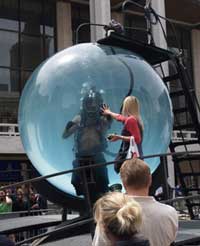
This opera was up-staged to some extent by Mr Blaine in his huge water bubble in front of the opera house. The entire quadrangle was filled with people and a out-door screen set up for the spectacle of seeing a fellow citizen almost drown. Intermission saw hundreds more craning from every vantage to take a glimpse of the magnified image of Mr Blaine. Apparently he broke the submersion record but not the breath-holding one (which may be held by Monserrat Caballe).


This Met run has been subject of much discussion. Marcello Giordani had pulled out some weeks ago and Cavaradossi was to be played by Franco Farina. The great draw-card was still Ms Voigt whose return to the stage last year, slim and post operative was also of great interest.


src="/opera/_images/tosca-poster-nouveau.jpg"
alt="Old poster of a long ago performance of Tosca" />
Old poster of a long ago
performance of Tosca


I have never heard so much male "wobble" on stage as in this first act. Three veterans were guilty of this rather major vocal sin. For Plishka and Morris there are compensations but for Farina there were none as he sang badly for the first two acts. He belted out his music in the most unfortunate manner such that I felt people around me cringing, as I was. Farina forced, bleated and crooned his way throughout the first act in a most unseemly and tasteless manner. He was quite loud and sang on pitch and that seems to be enough for some people. There was some respite in Act III when he produced some much awaited musical magic and 'dolcezza'. 'E lucevan le stelle' was creditable, despite a falsetto diminuendo, while the duet singing 'worked', including the unaccompanied 'triumph' declamation. Perhaps he was more relaxed by this time of the proceedings.


Voigt received a polite ovation even before she sang an aria. Her Act I performance was just fine and in Act II she surpassed herself in both the 'Vissi d'arte' and its drama. Voigt took the opportunity to stab Scarpia on two occasions and he took several bars longer than usual to die in Act II. Farina's 'Vittoria' section was on key and large but lacked any beauty. More 'cringe' music.


Morris sang strongly but his persistent beat is off-putting and ugly. His 'Te deum' scene was adequate. Some would have preferred his act three.


I am pleased that Carlo Rizzi did not try to put his own stamp on the music. His tempi were classical and sympathetic. His orchestra members know what they are doing - with prominent low woodwinds and brass as Puccini mandated.


Not a high point of opera going for me. But an opportunity for a new audience to see the magnificent Zeffirelli production. Just to be a bit picky about an otherwise splendid 'realistic' rendition, I still don't know why Baron Scarpia has a flimsy little single bed in his chamber (I don't recall it being used), nor is it clear why Angelotti is so well dressed after months in jail. The alter portrait would appear to lack the detail to recognise a face or even to tell if the woman is blond, as required in the libretto.


New York streets were in chaos after the opera due to the added spectacle, huge crowds, traffic, closed lanes on Broadway, ambulance and fire trucks to boot. I was pleased to be on foot.


Comments by Andrew Byrne ..

07 May, 2006

Il Tabarro / Gianni Schicchi

Hunter College


Sun 7 May 2006 3pm


Dear Colleagues,


New Yorkers who were not there missed a treat this weekend. Two of the three Trittico operas were great value at $30 per seat. In the small but adequate Danny Kaye hall we heard two fully staged works Puccini would have been proud of. Il Tabarro was set traditionally with most of the stage being a sideways barge on the Seine and the Paris skyline horizon of dusk beyond and a huge full moon.


The production of Schicchi was unique and original in several ways. Making a boon of the small stage, somebody had the brilliant idea of 'parking' Buoso's body within the frame of an old portrait up on a mantle (where it slipped on cue with dictation of the new will!). Additionally, rather than the skyline of Fiorenze, we have baby dolls' houses near the foot lights including many 'rooms with views' as well as Brunelleschi's Duomo, Santa Croce, Piazza della Signoria and Tower of Giotto.


As most readers know, the Trittico can be a difficult to mount as a Ring opera. Each is a gem of the theatre and nobody should have been disappointed at the members of the Mannes Opera, conducted by Joseph Colaneri, directed by Laura Alley on sets designed by Roger Hanna.


All twenty or more singers were excellent but stand-out performances came from Vira Slywotzky as Giorgetta; Young Joo An as Michele (and doctor/notary in Schicchi); Yonghoon Lee as Luigi; Andrew Ahlquist as the street singer; Chee Shen Tan as Rinuccio; Marcelo Guzzo as Schcchi; Sookyung Ahn as Lauretta.


The orchestra was strong, balanced and well led. The acoustics and size of the hall produced one of the loudest and most immediate opera experiences I have even had. Goose bumps all over on several occasions - more than the last three full operas at the Met, not that such comparisons are fair.


Congratulations to this small company. Professional standards at amateur prices.


Comments by Andrew Byrne ..

02 May, 2006

Rodelinda Gala

The Metropolitan Opera, New York City


Friday May 2 2006


RoleArtist
RodelindaRenée Fleming
GrimoaldoKobie van Rensburg
GaribaldiJohn Relyea
EduigeStephanie Blythe
BertaridoAndreas Scholl
UnulfoChristophe Dumaux
FlavioZachary Vail Elkind
ConductorPatrick Summers
ProductionStephen Wadsworth
SetsThomas Lynch


Dear Colleagues,


The Met Rodelinda is worth the price, if just for the beautiful sets. And remarkably, there were tickets available at most price ranges on the night. The first scene sees Queen Rodelinda and her young son locked up in their magnificent palace bedroom. Next, released from her chains, the entire stage rolls to the left, revealing the palace garden. It contains the family cenotaphs including one for her recently departed and presumed dead husband, Bertarido (played by Andreas Scholl, counter-tenor). The stage rolls on even further and we see a full sized stables, resident horse included. After a scene back in the garden, we find ourselves in the most magnificent library with six segmented galleries, mezzanine, skylights and panelled and serried shelves. A spiral staircase rises on the right with desk and chairs on the left. Yet another scene takes us to the bowels of the palace, secret corridor and all. It is here where the least likely part of this unlikely plot takes place as the imprisoned king accidentally stabs his friend with a weapon provided by his allies. Despite the injuries, both flee using the secret entrance.


I was surprised that Renée Fleming was paired with mezzo-soprano Stephanie Blythe who has a magnificent, velvet and very large voice. The opera does not contain duets or concerted singing in which such talents can combine such as Sutherland and Horne used to. Yet both women did shine individually, with a final magnificent tour de force 'resolution' aria by Fleming including a scale up to a stratospheric height. Sadly several of the patrons sitting near me had gone home by then.


I am never a fan of males singing in the soprano register (unless it is David Daniels) but I know I am in the minority. Scholl was extremely well received while the other men also sang creditably, especially John Relyea. The orchestra was in fine form under Maestro Summers who played harpsichord while at the podium. At times he seemed to have his left hand still on the keyboard(s) while raising the baton with his right to direct the orchestra.


href="http://www.metmuseum.org/toah/ho/02/wam/hod_1985.84.htm"
target="_blank"
class="nofrills"> src="/opera/_images/seated-female-200.jpg"
alt="Seated Female c.6000BC Mesopotamia or Syria" />
Seated Female c.6000BC
Mesopotamia or Syria


The story is as unlikely as any opera plot. Bernheimer in his review apparently called usurper Grimoaldo the "nemesis on the premises". I don't know why the program gives the title "Regina de' Longobardi" for Milan's queen. Also, I have never seen so much surgery on stage! It was like a trauma ward. There was a bound hand wound and an apparent laparotomy. At least in Forza the battlefield surgery happens off-stage.


Like Partenope, the opera may seem long and difficult to some. I would not mind if it remained a museum piece, resurrected occasionally by specialist institutions. However, 'rescue' for such a work is at hand by using a clever production along with exemplary singing as in this case. Handel experts may disagree, but to my ear, the opera lacks an immortal show-stopper. Rinado has 'Lascia, io piango', Alcina: 'Tornami a vagghagia' (Alcina); Semele with three such (Oh sleep; Iris hence; Where e're); Caesar has its arias and violin exhibition; Xerxes its 'Largo'. That said, Rodelinda has a plethora of delightful and varied music from all singers and orchestra and is more than a mere museum piece. There are many repeated refrains which could be cut back, making the long evening slightly shorter. I only recall one real duet in the whole piece, but it is worth the wait.


Curtain calls saw the crowds go wild - and honour was satisfied in every respect - but I will not be back in a hurry. While it is a privilege to see an old work done so well - like the Mesopotamian wing at the Metropolitan Museum - essential historically - but I don't want to revisit all that often.


Comments by Andrew Byrne ..

01 May, 2006

Met Rigoletto. Gavanelli trumphs. Water-sphere man a side show - only in New York!

Metropolitan Opera Company, Broadway and 64th St, New York City


1st May 2006


RoleArtist
RigolettoPaolo Gavanelli
GildaNorah Amsellem
DukeRoberto Aronica
MaddalenaNancy Fabiola Herrera
GiovannaKathryn Day
SparafucileRobert Lloyd
MonteroneJames Courtney

ConductorAsher Fisch
ProdOtto Schenk
Set and costumesZack Brown
LightingGil Weschler
Stage DirectorSharon Thomas


Dear Colleagues,


This was a welcome surprise in the middle of a month of opera in New York. I had not heard Aronica or Gavanelli before but they were both magnificent artists with special qualities to savour. Ms Amsellem was also interesting, possessed of a strong, highly placed, pure soprano voice. She took the penultimate E flat in 'Si, vendetta' but avoided the high options at the end of the quartet and storm scene. 'Caro nome' was sung tastefully, ending with a long, accurate trill.


In several places, notably the first act 'La maledizione' and the end of the tempest scene, the orchestra was too loud for the singers to be heard. Mr Aronica omitted his (optional) high note in the second act cabaletta as he is 'called to his love' (like most other tenors). "Quest'e quella" was excellent with a finely schooled chorus for the opening party scene.


"Cortigiani, vil razza" was a tour-de-force by Mr Gavanelli. The quality of his voice has a rich velvet reminiscent of Warren and a forte/piano approaching that of Milnes. The voice is very large but he uses the full range tastefully unlike many other on-off singers.


Fisch took the orchestra at nice paces with the above proviso on volume. He may forget he is conducting one of the largest opera orchestras in a hall with excellent acoustics.


The production is another Otto Schenk collaboration - beautiful and 'realistic', transporting one to an imagined past time in Mantua. Not a detail is spared . from bare winter vine strands on the roof balustrade to wild grass growing in the floor tile cracks away from the pallazzo. The last act, set in the outskirts is particularly clever, incorporating the river bank, wharf and hostellery. Even at the Met it seems impossible to avoid an audience gasping with recognition with 'La donna e mobile' . which was masterfully sung by Mr Aronica with a marvellous finale scene in-the-sack. His finale exclamation was little less than magnificent, earning a deserved ovation from the demanding Met audience.


Comments by Andrew Byrne ..


David Blaine
David Blaine

(Added side-show was David Blaine in his sphere of water next to the Lincoln Centre fountain - WEIRD!!).

21 April, 2006

Lots lacking in last night's Lohengrin. But much great opera, too. Heppner, Mattila, Fink, DeVol.

Met, Lincoln Center


20 April 2006


Dear Colleagues,


The 3 long acts of Lohengrin at the Met gave us "the best of times and the worst of times". Karita Mattila, who we had the privilege of meeting briefly after the performance, was magnificent as Elsa. Her range is wide, voice sizeable and she is accurate and musical to a fault. But the production and some vocal problems made it hard to "enjoy" this Lohengrin. I recall seeing it about 6 years ago and it was an endurance then as well.


This revival still has all its elements in place, even though some changes may have been made. Gilbert and Sullivan did it for ONE single aria ('You hold yourself like this; you hold yourself like that ...' from Patience) but these singers had to "do it" for 5 hours! For every moment on stage, every performer from King to chorister had to appear stiff and stylised 'like a Japanese marionette' (Mikado). White faces of the principals and blackened faces of the chorus seemed to have no particular meaning. Hand movements were meticulously choreographed throughout. At one point in a darkened stage, all principals had ONE hand individually illuminated to no particular effect . which would have been invisible from much of the 4000 seat hall. Also, all male leads had similar facial hair and dark costumes which is impractical for such a stage work.


The opening becomes a 'Trial by Jury' scene with King Henry as judge, Elsa the accused and Telramund as plaintiff while Lohengrin (as yet unnamed and unnamable) is chief witness for the accused. The mystery witness wins the hand in marriage of Elsa ... on condition of keeping his anonymity. Could a story be more Gilbertian?


Stephen West was ill, so we heard Andrew Greenan as King Henry. But the replacement was obviously also indisposed as his voice disappeared not long after his strong opening. His low notes were inaudible and his mid range seemed to be obscured by phlegm and were garbled or gargled. He was clearly uncomfortable, as was the audience. So where was Rene Pape when we needed him? Answer: in the audience! He is scheduled to take over the part on Monday.


Mr Heppner sang strongly and acted well in the first two acts. However, when he needs to shine in Act III things were not comfortable for him, either. He seemed to be curtailing some notes, singing a few 'glottals' and indeed just about 'cracked' on one high note in his aria. As a consummate professional, he knows how to recover and control things, but this inevitably means losing some of the excitement of the piece and losing some confidence with the audience. I do not know why his final song to the swan is sung facing away from the audience. It is just another crazy decision in a crazy production.


Many of the tableaux were very beautiful, using a bright, clear background, sometimes sky blue but often multicoloured, there were silhouettes, shadows and large fluorescent boxes in the foreground but otherwise bare stage settings. The overall impression of the production was that the characters were not human, the emotion was all artificial and the story needed no telling. This is contrary to what Wagner wanted in his usually detailed stage directions and is certainly not want I want to see in the theatre. While all opera plots have ludicrous twists, the point is that these 'twists' lead to many different circumstances where great emotion can come out using singing and orchestra. And when singing these 'high points' there needs to be great freedom for the singers to put all their energies into singing. Here they were constrained severely by the direction.


I have enjoyed Lohengrin elsewhere and had hoped to be won-over by this production. But it was not to be . even from the best orchestra seats. Remarkably, there was no wedding, which had to be imagined. Telramund actually got up and walked off stage after his murder (second time unlucky) . and his body was invisible in the stretcher carried back on stage. Weird!


A delightful surprise was a wonderful performance from Luana DeVol as Ortrud. She was glorious with full throttle, ringing, high soprano voice and exemplary dramatic sense. Richard Paul Fink, another true Wagnerian, was an impressive and comparably equipped Telramund.


The orchestra under Maestro Phillippe Auguin was magnificent. He sometimes looked to have his eyes closed while conducting music he obviously knows by heart. During the wedding music opening Act III he positively jumped on his podium, enjoying every glorious second. We learned afterwards about some foibles of the Met and its new management. He also tells some spicy behind-the-scenes opera stories from Europe, Australia and beyond (is there anything beyond Australia?). He was in his element last November in the Beijing Ring from Nuremberg.


comments by Andrew Byrne ..

13 April, 2006

Fidelio at the Met. 8 out of 10!

The Metropolitan Opera, New York City


8pm Thursday 13th April 2006


RoleArtist
JaquinoGregory Turay
MarzellineJennifer Welch-Babidge
RoccoKristinn Sigmundsson
LeonoreErika Sunnegardh
Don PizarroAlan Held
First PrisonerDimitri Pittas
FlorestanRichard Margison
Don FernandoJames Morris
ConductorPaul Nadler
ProductionJurgen Flimm


Dear Colleagues,


This performance rounded off an entirely successful Fidelio season for the company. Not only a New York Times article about 'waitress to soprano' but also a reported minor vocal mishap on her opening night yielded publicity well beyond the normal. Ms Sunnegardh was second cast to Mattila's prima donna which I did not hear.


This up-dated production by Jurgen Flimm and Robert Israel is clever, stylish and sympathetic to the book. The 'rescue' opera takes place around 1960 in a repressive European political regime. Although the set was a 19th century prison, fluorescent lights, supermarket shopping bags and tailored military uniforms brought us into the middle of the 20th century. In a brilliant contrasting coup, the final scene moved on without a break from darkest dungeon to bright square outside. Against a bright blue horizon, we saw an equestrian statue (under construction) of Don Pizarro in the guise of Emperor Marcus Aurelius. Its defacing by the crowd was reminiscent of the toppled Saddam in another failed dictatorship.


The final jubilant chorus was adrenalin-plus. Each principal singer could be clearly heard as well as the orchestra and chorus in their turn. And while the opera has dramatic imperfections, the finale must be one of the most joyous pieces of musical writing anywhere in opera. And there is the awkward and dramatically unsatisfactory 'side show' of Marzelline discovering that her betrothed is actually a woman. Joachino is her consolation prize.


Typical of the Met, most performers had long CV's. Conductor Mr Nadler was not typical of the Met as James Levine had injured himself in a theatre fall recently requiring shoulder surgery. Yet there was a feeling that Levine was there in spirit, rubato and all.


'Swedish American' Ms Sunnegardh as the title role was the newcomer, her career debut being in 2004 according to the program. She has a impressive, penetrating, accurate and large voice, especially secure in the high register. Her performance earned a rare standing ovation at the end from a substantial minority of the audience. She seemed overwhelmed by the reception.


Icelander Kristinn Sigmundsson sang Rocco to a perfection. Somewhat reminiscent of Kurt Moll, he has a large frame and matching velvet vocal output.


Richard Margison commenced his act with a pianissimo 'Gott' and sang the rest with power and pathos as required.


The first felon, Dimitri Pittas, sang some charming bars on being released into the sunlight. A clever touch put him into a dog-collar, worsening the impression of the police state imprisoning a cleric.


I doubt that James Morris would get his full fee for the cameo appearance as Don Fernando, yet he sings with suave authority if with a distinct beat at times.


The Met chorus was in finest form, being brilliantly directed such that there was a paucity of movement in the prison scenes yet mirth and frivolity emphasised at the end with corresponding activity, dancing, etcetera.


All in all a triumph for the Met. I'm not sure if that can be said of all their recent shows.


Comments by Andrew Byrne ..

20 February, 2006

Die Zauberflöte. Sydney Opera House 20th February 2006

Fly the Flute fantastic ... Mozart and Schikaneder would be proud!

Die Zauberflöte. Mozart. Sydney Opera House Monday 20th February 2006.

Tamino - Jaewoo Kim
Papageno - Warwick Fyfe
Queen of the Night - Amelia Farrugia
Pamina - Emma Matthews
Sarastro - Stephen Richardson
Three ladies - Sarah Crane, Catherine Carby, Sally-Anne Russell
Monostotos - Kanen Breen, Papagena - Taryn Fiebig
Speaker - Jud Arthur, Priest - Graeme Macfarlane
Cond. R. Hickox.
Director David Freeman
Design Dan Potra
Choreography Debra Batton

Dear Colleagues,
The Sydney summer season of opera has reached its half-way point with a spectacular new production of Magic Flute by David Freeman and Dan Potra. Julie Taymor of Lion King fame brought new Magic to the Flute in New York last year using giant puppets and a circus approach. Freeman and Potra bring their own joint genius to this colourful show in which fire and water really ARE fire and water. And priests wear saffron and crimson, with dark sets as panels of pietra dura which are variously ‘back’, edge or front-lit. The three temple doors lift out of the floor, so no scene change is needed. The busy, fenestrated set opens and closes to produce small intimate scenes in ‘cupboards’ or vestibules to an open stage when space is needed.
It would take reams to describe all the splendid stage craft, scene by scene so I will just stick to the most memorable. The first act opens onto a vine strewn jungle. Our retinue of actors are climbing ropes and ladders, some initially hidden in the undergrowth. We are accompanied throughout the opera by quadruped furry friends including lions (or were they baboons, the Egyptian symbols of the dawn and light?).

Our dragon is shown as three huge moving sections: ‘vicious visage’ head suspended, massive single claw and writhing serpent body. Our eastern prince was tall, imposing Korean Jaewoo Kim, dressed in finest oriental silk. He sang and acted exceptionally well. His fellow traveller on the trials to happiness was played equally well by Warwick Fyfe. With a strong voice and good comic sense, he arrived on stage looking like a younger Les Patterson (rhinophyma nose added), with his own personal barbecue and beer cans. While readers may wonder, most of this Oz-ock take-off was tasteful … and in appropriate contrast to the regal nature of his company. Even Australian accents in the (English) dialogue did not seem out of place between the arias, sung in German. Australian gags brought much mirth and were worthy of ‘Barry McKenzie’.

One of the ‘vestibule’ scenes saw our two heroes about to embark on their trials, as if seated in twin electric chairs. Next, the entire chamber started revolving through 90, then 180 degrees, the articulated chairs remaining upright but stopping at the ceiling rather than the floor. Later the same room served Papageno climbing for dear life as it spun again unexpectedly. It also became a more intimate setting for his ‘reviving’ scene when he receives a tin of beer rather than the traditional glass of wine.

Another splendid ’effect’ occurred when the Regency couple had weathered the water trials and appeared suspended behind a wall of flowing water. The spray curtailed, they walked through to a sort of Olympic medal ceremony. As if in need of a final pièce de resistance, but to no more dramatic effect, the common couple were ‘walled’ by vertical jets of water at the end of their duetto.

Our nocturnal Queen arrived from the sky, suspended on a bright yellow translucent quarter-moon. Ms Farrugia managed the impossible tessitura with slightly pinched yet still accurate highest notes and a regal presence. Oddly, Tamino spent the aria looking up the Queen’s white stranded dress which extended down to the stage several metres below. Her second act aria was even more impressive, now back on the ground, as she tries to sway her daughter Pamina against the wicked Lodge men.

Emma Matthews was excellent as Pamina both vocally and dramatically. Stephen Richardson made a fine Sarastro and it is hard to believe that he gave us such a good Falstaffo so recently. He had all the low notes as well as the authority to carry off this very different role.
At the animated curtain calls there appeared no sign of Dan Potra, David Freeman or Debra Batton who created this extraordinary production for us. They deserve a major accolade, along with the dancers, jugglers, flame throwers, acrobats and silent muse stage assistants. The orchestra sounded in control throughout although the first notes were so staccato that they sounded to be unison from my seat in the circle. Mr Hickox beat a strict pace while carefully co-ordinating the whistles, pipes, bells and other extras required in this unique masterwork.
I imagine the season will sell out very rapidly since this is full Magilla theatre of Olympic standards. It makes a night at Butterfly seem rather staid!

Other recent successes from the opera company have been Falstaff, Butterfly and Elisir d’Amore. Rake’s Progress is next.

Comments by Andrew Byrne ..
~~~~~~~~~~~~~~~~~~~~~~~~~~~~~~~~~~~~~~~~~~~~~
Dr Andrew Byrne MB BS (Syd) FAChAM (RACP)

28 February, 2005

Fine Fledermaus in Sydney, awfully amplified

Sydney Opera House


Friday 25th February 2005


RoleArtist
AdeleAmelia Farrugia
AlfredoAndrew Brunsdon
RosalindeMiriam Gordon-Stewart
EisensteinAngus Wood
JailerJonathan Biggins
withChristopher Dawes,
Tim DuFore,
John Bolton Wood,
Catherine Carby.
ConductorNicholas Braithwaite


Dear Colleagues,


This Autumn season we are again treated to a marvellous romp based on Johann Strauss's classic, set in New York, in English (of a sort). The action starts with Adele talking on her mistress's telephone in their grand high rise deco apartment.


For me the high point of the opera is the song of the 'Princess'. Ms Gordon Stewart did it fine vocal justice using farcical but somehow fitting new English verse. Just as the pseudo-French "Renard" and "Chagrin" use pig-French: 'voulez-vous coucher avec moi, ce soir?', our mock Hungarian juggled her words. She even had to correct herself, 'Budapest' for 'Bucharest' in her hitherto serious homeland 'czardas' anthem. She looked out onto (land-locked) Hungary's "rolling seas" rhyming with the walls of its "factories"! Although taking a risk playing a 'Sutherland' role in Sydney, this soprano was equal to the challenge, singing with charm, elan and power. She even hit a sustained high last note, rather than scooping (or omitting) it.


Ex-pat Russian millionaire (?Putin refugee) Orlovsky then announces "Ginger Rogers and Fred Astair" will dance to Irving Berlin's tune 'Cheek to cheek'. So too did the accomplished opera chorus, again showing their versatility and professionalism, dancing on to the Blue Danube Waltz. The champagne is followed by a nasty hangover which occurs in 37th precinct lock-up with the night duty sergeant typewriting his new novella. The clever English 'translation' by Pountney and Hancock, suitably supplemented with topical people and events made for a hilarious continuo. Mr Bolton Wood as Frank could not have been more amusing while Jonathan Biggins (NYPD) deserved an accolade for his clever 'graveyard shift' scene in the Precinct. Farrugia twice took the stage to impress as a budding 'airctress'. Both her laughing song and third act 'audition' were brilliantly acted and sung. Brunsdon played a fine Alfredo, adding yet another accent. As implied in the libretto he plays an imperfect 'can belto' tenor who lets us know. Angus Wood again justified his decision to move from baritone to tenor register.


The essence of Lindy Hume's original production has been maintained and updated in this staging by Elizabeth Hill. The orchestra seemed to be having a great time under Mr Braithwaite. They were even called upon to play the ABC news theme at one point!


Overt amplification is irritating and unnecessary in the opera house. It detracts from the most important aspect of this expensive art form, voice quality, size and projection. These singers are nearly all trained to fill opera houses and it is demeaning to them and vexing to an opera audience to hear reverberations and uneven electronic fortification of both musical and spoken parts. Feedback is fatal. Most off-putting were momentary increases in volume when singers came close to colleagues' lapel microphones. If there are some 'dead' areas in the auditorium then some subtle 'enhancement' may be appropriate but in general this should not be needed in my view. If people think that the dialogue needs enhancement I suggest they look at the titles, or the speakers should be turned off for the singing. I heard no complaints from all the dialogue in Carmen last week in this smallish theatre with relatively kind acoustics.


While I found them quite amusing, a native may have found the various local 'American' accents bewildering. In fact, Manhattan has always been replete with accents, even Australian ones!


Another exciting addition to the summer/autumn season at the Sydney Opera House.


Comments by Andrew Byrne ..

21 October, 2004

Le Comte Ory. Another auspicious night for the local opera troupe

Canterbury Opera, Christchurch, New Zealand


Thurs 21 Oct 2004


RoleArtist
Count OryBernard Hull
Countess AdeleEmma Sloman
Isolier, Count Ory's PageMajka Kaiser
Raimbaud, Ory's 'friend'Richard Grundy
TutorValeriy Maksymov
Ragonde, Countess's companionMaree Hawtin-Morrow
AliceHelen Charlton
A knightJack Bourke
c.Michael Joel
d.David McPhail


Dear Colleagues,


This was another auspicious night for the local opera troupe.


It would be unfair to compare with the great opera houses of the world, but quality needs to be sought and acknowledged wherever art appears. And the quality was high. No flat singing, no embarrassing gaffs, no scenery collapses and an orchestra of a good standard and size.


The modern theatre has charm and includes a 'floating' balcony. It forms part of the Town Hall complex near the Avon 'River' whose botanic banks are currently displaying the wonders of spring including cherry blossoms, horse chestnuts, tulips, etc. The subtitles were by way of TV screens and only gave about one line in ten of the English text. The translation by Brian Castles-Onion was clever and racy but at times laboured by plosives ("Good enough, good enough" repeated over is not easy for singer to instil beauty musically).


I am not sure why proceedings were moved from 11 century crusader times to the 1700's. There were no crusades in the latter period, apart from the soi-disant '4th crusade' to the Americas. Costumes were probably more difficult for the change but all were colourful and tasteful. The settings were projected Rococo scenes on a huge white circle backdrop on an otherwise plain stage. It worked for me. The castle drinking scene with Ory and his 'nuns on the run' was brilliantly staged. Slapstick allegory with the last supper would only have offended the most orthodox in the audience.


I had the privilege of seeing the opera at Glyndebourne in the 1990s and enjoyed the chance to see it again. Despite many memorable musical moments, Ory lacks an 'immortal' aria. The overture is inauspicious and, rather than capitalising on his genius for the catchy tune and orchestral innovation, Rossini may have been experimenting with tempi and other more subtle effects in this, his second last opera before the long composing 'silence'. Some Ory melodies are almost trite yet some features were quite novel and worthy of his successors. Most come from his 'Viaggio a Reims' written for the coronation of the last French Bourbon King and not reproduced on the usual opera 'circuit'. The act one finale has a wonderful descending orchestral ornamental device re-used by Strauss almost exactly at the end of the Fledermaus overture. I also noted some repeated cadences which I have only heard elsewhere in Verdi's operas, written years later. Another duet/concerted piece is similar to the 'Tous les trios reunis' in Figlia del Regimento of Donizetti.


Bernard Hull was the star of the piece as Count Ory. He is from Adelaide according to the programme notes and did a Hoffmann here in the past. He has a highly placed tenor voice suited the to this very difficult role. Like Rockwell Blake, he can sing high, long and loud . and then do it all again, and again, for a whole evening. The voice can sound a little harsh at times but he uses carefully placed diminuendos to soften and sweeten the effect. He also has a confident stage presence, communicating much with his eyes and gestures. Hull also still possesses youthful good looks.


Emma Sloman as the Countess also had some taxing highly placed singing. She managed but may have tired towards the end. Her wig was extraordinary, as was Ory's. Once again, she did coloratura alone, in duet and with chorus, each being exciting and in-character.


As Ory's Page, Majka Kaiser was excellent. The bedroom scene was hilarious with the three in bed singing, acting and cavorting at the one time.


The others all sang well and the continuo was in fine form. The orchestra under Michael Joel played creditably.


All in all an uplifting and positive experience for a tourist from Sydney. And so reassuring to see a small city like Christchurch (pop 400,000) having an active and high quality opera company.


comments by Andrew Byrne ..