Andrew's Opera was previously published at http://www.redfernclinic.com/

24 January, 2010

Manon Gala Sydney Opera House Fri 22 Jan 2010

Manon - Jules Massenet - Sydney Opera House Friday 15th Jan 2010


This opera gala was another success in nearly every respect. For reasons known only to the current management, five acts and six scenes were only broken by one long interval, not two, for this revival of Stuart Maunder's traditional and rather beautiful production. The continuous action can be torture on the singers' vocal cords. It is also tough for the orchestra/chorus, difficult for the audience and a profit-buster for the house bar and caterers. While it shortens a long night at the opera, it does so at an unacceptable price in my view. Massenet apparently intended four breaks! But what would HE know?

Amelia Farrugia shows that she has what it takes - and that is a whopping big talent, voice and presence to carry off this enormous role. Her town square gavotte song drew a great ovation from those on stage and in the theatre. She spanned the gamut of emotions from teenage adventure, intimate love to public adulation and beyond with her own death scene.

Julian Gavin is possessed of a warm, natural tenor voice and was magnificent, especially from the St Suplice scene onwards. His 'En fermant les yeux' (The dream) seemed somewhat 'studied' but by the time he sang 'Ah fuyez, douce image' in the church scene he was incomparable, as he was in the tragic finale.

Stephen Bennett was an excellent father figure. It is hard to understand why he was not seen or heard for so long but gratifying his substantial talents are now being used again, albeit in some smaller roles such as the doctor in Traviata (which could well be played by an aspiring newcomer).

Possibly Australia's pre-eminent young baritone Jose Carbo likewise is 'under-parted' as the eligible Lescaut, cousin of Manon. Both Bennett and Carbo should be singing big roles, title roles and be 'stars' of the opera, yet neither has been given a significant challenge in some years. Carbo did a superlative Barber of Seville in 2004. It is hard to understand why someone who has a contract with La Scala is currently only singing secondary (if still substantial) roles in Sydney. Much more common, sadly, is the reverse where less capable singers are given tasks beyond their abilities as part of casting mysteries which happen in the national company.

This production has Kanen Breen portraying Guillot de Monfontaine as a campy calculating and unpleasant 'dirty old man'. This seems unnecessary when the character can, at least initially, be portrayed as a sympathetic if slightly pathetic sexed-up old man, only later to become the litigious protagonist. While we can never know exactly what Massenet and his librettist wanted, I doubt if it was the caricature played by Breen. The director has him drawing attention to himself rather than the opera's story line in my view.

I still find that Manon can be long and difficult - unless it is done to perfection - I recommend the Netrebko and Villazon DVD from Berlin. Apparently Sir Thomas Beecham is quoted as saying that Manon by Massenet would take precedence over JS Bach's Brandenburg Concertos if there were ever a choice to be had.

We should never lose sight of the fact that the orchestra and chorus performing with our national opera company in Sydney are of a high standard. Maestro Emmanuel Plasson conducted inconspicuously and with appropriate aplomb.

Throughout the hall on two Fridays in a row there were company members sitting in good seats, presumably free or at reduced prices, showing that even on a Friday night in high tourist season with one of the best known operas in the canon there seems to be a problem with the opera company's marketing. The previous Friday's Tosca opening was a full house but this Manon I estimate was only 85% sold and many seats clearly were 'papered'.

It is gratifying to have experienced two successful openings in a fortnight but this needs to be followed up with continued high quality opera and good marketing. Too often in recent years performances have been marred by replacements, ill-prepared singers and even absent understudies. Furthermore, the best seats are now $297 which is more than the best 'orchestra' seats at the Met in New York. Yet "rush" seats are sold for $50! While this is a bargain, it is also a slap in the face for regular subscribers who are the main supporters of the company.

Comments by Andrew Byrne.

Opera blog: http://www.redfernclinic.com/opera/critique/blog/

New York, restaurants, recipes: http://ajbtravels.blogspot.com/

10 January, 2010

Tosca at the Sydney Opera House directed by Christopher Alden.

Tosca - Friday, 8 January 2010 - Sydney Opera House.

Dear Colleagues,

Despite all the critical hoopla over this updated production I enjoyed it and would rather like to see it again. The solo voices were magnificent, orchestra in fine form under Andrea Licata and company chorus singers doing their usual professional job.

The mod-drab production would take several pages - even to describe the essentials - and others will do that I dare say. Tosca does not jump in front of the A-Train in Act III but she does not jump off the Castel Sant’Angelo either! You will have to go along to see how the ending of this ‘shabby little shocker’ has been made - certainly more shabby and in some respects more shocking.

We saw the clever arrival in church (actually the vestry) of the Marchese Attavanti in Act I during the Te Deum commotion (the Te Deum has become a parish raffle). Played by Sian Pendry, the beautiful blue-eyed blonde of the story, normally only seen in her portrait, manages to hide in, behind and then atop the confessional box which also serves as the family capella. She responds mutely to the various pieces of news about her brother, the Napoleonic advances and Scarpia’s bad behaviour. Act III is run straight from the end of Act II and it all seems to ‘work’ somehow with the Marchese singing the sad shepherd boy’s song (in tune, unlike some boy sopranos). Her brother’s ‘body’ is brought in, obviously a rag-doll mock-up, and strung up as demanded in the libretto but not normally seen on stage (and to the sister’s mute horror).

There were innumerable other details to this production, many stemming from the story (like the electrocution used for torture) and others seemingly out of nowhere. All were thought provoking and some were quite humorous. Spoletta and Sciarrone were presented as disinterested henchmen who despised Scarpia, just like everyone else. They even conspire to facilitate his stabbing. Surprisingly, each gets a laugh at times in this otherwise grisly thriller.

The death of Cavaradossi remained a mystery to me, as if he just died of delayed electric shock and somehow Tosca could tell as much from the other side of the stage: ‘Presto su, Mario’. There were a few other incongruities - such as how did Cavaradossi ‘fail to recognise’ Angelotti when he was still in the next room (or confessional)?

Rosario La Spina sang brilliantly. His high notes were ringing, his low register secure but with a few glottals and possibly phlegm briefly present. His acting was just fine and compared to Pavarotti he was academy award material. He even youthfully bounded up a tall window frame with Angelotti to make their escape from Scarpia and his hounds in Act I.

Ms Takesha Meshé Kizart gave a sensuous and sensational performance. In contemporary dress and literally ‘to kill’, she was jealous, loving, superior and finally stoic in the face of death. Boots, dress, Ray-Bans and gossamer hair. Her Vissi d’arte was a triumph and the ovation she received ecstatic. The final audience applause included a huge and prolonged standing ovation by a large majority of the stalls patrons but also with a small number with prominent boo’s, largely when the design team finally came out for their own curtain call.

John Wegner, like his stage colleagues, rose to great heights with his portrayal of Scarpia. He had to eat pizza, assault numerous males and rape the heroine and all while belting out a grand velvet tsunami of vocalism. Accolades in anybody’s language.

It must be rare to fine a Sacristan with a louder voice than the other principal singers. Warwick Fyfe did a sterling if coarse and unsubtle job in the minor clerical part … also doubling as jailer in Act III which took place as a continuum from Act II without a break still in the vestry of the church on (or off) the Corso Vittorio Emanuele II. Fyfe smoked, coughed, grumbled, genuflected and lit the 12-volt miniature of Jesus … while also doing the gaoler’s bidding in Act III.

Full marks also to Maestro Michael Black and his chorus who provided an excellent and original Te Deum scene and then the off-stage cantata in Act II. Puccini called for an off stage chorus in numerous operas including Madam Butterfly. The chorus appreciate this as they can scrub up, do their last scene and go home early. Puccini also knew the benefits both in drama and practicalities of having his soprano sing initially off stage, a device he does not only use in Tosca. ‘Mario, Mario, Mario’ (shades of ‘Maria, Maria, Maria’ by Bernstein).

The opera finished early, allowing us to take a full and wholesome supper along with the inevitable operatic autopsy.

Unanswerable questions will arise about whether it is appropriate to do anything with this opera after the glorious authentic enstagements of Copley, Zeffirelli and others. If your answer is ‘no thanks’ you need to stay home. Otherwise, with great singing and Puccini’s immortal score this will not fail to exotically entertain.

Comments by Andrew Byrne ..

Opera blog:
http://www.redfernclinic.com/opera/critique/blog/

24 December, 2009

Australia's national "opera company". Is it a joke?

Dear Colleagues,

At last there is a ray of hope from our national opera company with the last minute engagement of Ms Kizart to sing the role of Tosca following the withdrawal of Cheryl Barker. Ms Kizart’s YouTube clip of ‘Tu che le vanita’ from Don Carlos is very impressive and she should make a fine Tosca in this new, updated production. John Wegner as Scarpia and Rosario La Spina as Cavaradossi should combine to make a marvellous first cast.

There seems to have been nothing but bad news from the national company in recent months and now, due to the expense of building the new Benedict Andrews production and the ‘financial risk’ involved, the company has regretfully decided to re-present the Neil Armfield production instead this season.

Lisa Gasteen, who was billed to sing Fanciulla del West, has also unfortunately withdrawn, as she did from last season’s Fidelio.

The impeccable Emma Matthews was unwell for much of the Sydney season of Montagues and Capulets but we look forward to hearing her again in Candide in the Parks Concert in January with David Hobson who is finally making a welcomed return to opera in Sydney with the national company. NOT TO BE MISSED! I hope it is televised.

Wishing all readers a safe and sound holiday season,

Andrew Byrne ..

See tides and tidings posting on web site: http://ajbtravels.blogspot.com/2009/12/king-tides-and-kind-tidings.html

01 November, 2009

Tosca and Rome - both immortal.

Tosca and Rome - both immortal.

It is worthwhile spending some time with this opera before moving on to the Wagner.

Tosca is rare in the field of opera regarding its ‘realism’. The events of the opera mean that its date is exact. Napoleon was then conquering areas well beyond France. You might say it was one of the many attempts to unify Europe which has now happened peacefully with the same currency, foreign policy and trade laws for most of the countries. The Battle of Marengo is mentioned in the text somewhere and 1799 was the year. He had already tried to conquer Egypt!

Further, each act takes place in a location which actually exists … and most tourists to Rome will see at least one of these either on purpose or just because they run into it. Opera fans will make a point of seeing all three! The church of Saint Andrea del Vallé is in the Corso Vittorio Emannule II and is magnificent … but no more magnificent than a dozen or more churches in Rome. The Farnese Palace became the French embassy. The Castel St Angelo has a long history and it is said that whoever holds this castle ‘will hold Rome’. It was originally a tumulus burial monument for Nero I believe and has since been built on, used as a prison, palace and tourist attraction. While it is not far from the Vatican itself, I believe there used to be tiny, narrow streets which Mussolini bulldozed to create the now magnificent avenue leading to St Peter’s square. It had been hemmed in for hundreds of years and pilgrims had to weave their way past the poor district to get to see the ONLY completed cathedral in the entire country (I kid you not). The Pope now owns the Castel St Angelo and he apparently has a small apartment there. Although it is huge, most is just firmament with ramps, stairs, tunnels, etc within. Its fenestrated battlements are recognisable for miles around and it is literally on the Tiber River, with only a small but busy two lane road in between, not to mention a little bridge directly in front … called (naturally!) the Ponto St Angelo.

So this opera is very popular, perhaps the 6 or 7th most popular of all operas at a guess, slightly after the famous 1,2,3 or “ABC” (Aida, Boheme, Carmen) of opera which no company can ignore in ANY season without risking bankruptcy.

Maria Callas was the most famous exponent of the part but Monserrat Caballé made by far the most impressive recordings of ‘Vissi d’arte’, the very famous soprano aria (act 2). Apart from this, the opera is famous for not one but two immortal tenor arias, ‘Recondita armonia’ (act 1) and ‘E lucevan le stelle’ (act 3). Pavarotti (and most famous tenors) often sang one or even both of these two in their concerts.

This is also a good demonstration of the difference between a coloratura soprano and the dramatic soprano. The former, ‘a big canary’ would be taking big risk in attempting this role while the latter is more like a vocal locomotive for whom it is a gift.

So, get with the strength and vote number one: “TOSCA!!”

18 October, 2009

Peter Grimes at Sydney Opera House.

Peter Grimes: Britten. Sydney Opera House 2009 Thursday 15th October 2009

Dear Colleagues,

This was an extraordinary night at the opera, honour being had by all. Even the fussiest Britten fan should not be disappointed by the overall effect of this production. It was set in a classic 20th century British community hall, complete with angled windows, swinging double doors, wall clock, hanging fluorescent lights and curtained stage with central steps for prize recipients. Only the portrait of ‘her maj’ was missing.

Maestro Mark Wigglesworth was the hero of the evening as he conducted an experienced and well placed orchestra with flair and knowing enthusiasm. Full-throated Australian international tenor Stuart Skelton played the title role with sufficient ambiguity to be sympathetic, despite the obvious negatives. He sang Grimes to the cleaners with extended, exciting high and mighty vocalising. He also managed to often appear shy and insipid dramatically to augment the uncertainty about his motives and circumstances.

Ms Susan Gritton played a fine Ellen Orford with an incising and substantial soprano voice. I note that she has recorded with Pamela Helen Stephens under Richard Hickox. While her portrayal was marvellous it is hard to imagine that there is no Australian soprano available, despite the challenges of this role.

Peter Coleman-Wright was an effective (retired) Captain Balstrode. The two chirpy nieces were played well by Lorina Gore and Taryn Fiebig. Kanen Breen was appropriately cast as the clergyman.

Along with the solo village characters (David Corcoran, Richard Anderson, Elizabeth Campbell, Andrew Moran, Peter Carroll and Catherine Carby) the chorus was excellent. They acted separately and then in concert, unity and purpose when required.

The opera is meant to take place in numerous locations from the seashore to boat house to village court house. With ubiquitous modern economies we see almost the entire opera take place in the village hall. Ropes, tackle and nets are carted through the hall as if it were the marine seaside. A boat is even dragged through the building which is beyond bizarre. Lightning occurs inside and a storm is quite cleverly mimicked within. Such is modern opera. At one point the rear proscenium is pushed forward to become the fisherman’s cliff-top hang-out for the death scene.

As in the excellent old John Copley production in 2001 we were presented with apprentices who were very young pre-pubertal boys rather than the mid-teenagers one might glean from Crabbe’s source poem - and its libretto by Montagu Slater. I find Slater’s constant scrambling of English grammar to be tiresome, despite its initial cleverness. Peter Grimes is a 20th century masterpiece but it is clearly not everybody’s cup of tea as the theatre was far from full, even with large numbers of free tickets given away. This may be one of the company’s best efforts this year. The audience literally screamed at the end with cheers for all those involved.

For those who enjoy Benjamin Britten (I exclude myself) this opera is a ‘must-see’ … and there are only 5 more performances (one being on Saturday night, after only one day’s break!).

It seems unbalanced and unfair that most operas billed to be conducted by the musical director in recent years had internationally acclaimed casts singing with the best of Australia’s resident opera singers. Peter Grimes has five artists who have reputations at a high international level (Wigglesworth, Armfield, Skelton, Gritton, Coleman-Wright). At the same time most of our other operas this year have had only one or two who might fit this category - some had none. While less notable productions of La Boheme and Cosi fan tutte were televised by the ABC, the operas with world-class casts and productions were passed over for mere audio recordings with an English record company, denying posterity the sight of such unique performances from down-under.

It is sad to see such a poor quality televised production of Cosi fan tutte recently on the ABC. While it was not as bad as last year’s La Boheme, there is still a major contrast with previous video efforts of this company as well as with modern high definition broadcasts from New York and elsewhere. There were no sub-titles. The commentary was excruciating. Jennifer Byrne’s cues (no relation) were visible written on the palm of her hand! While there was some fine singing, the production and camera work did not compliment it. I have just watched the second half of Les Huguenots from 1990 and it is superior in every way.

Comments by Andrew Byrne ..

New season comments: http://www.redfernclinic.com/opera/critique/blog/
New York, restaurants, recipes: http://ajbtravels.blogspot.com/
New York in 1922 from grandfather: http://bpresent.com/harry/code/10b_bowery.php
Travel log: http://www.redfernclinic.com/c/2007/10/lord-howe-island-naturalists_4153.php4
Shul notes: http://cantorialcrossoverculture.blogspot.com/

01 October, 2009

2010 season for the national opera company advertised.

Opera season 2010 hard to understand ... preliminary summation.

I read through the next season’s OA brochure with a feeling of persistent and profound disappointment. It would appear to be the final nail in the coffin of a spent company whose direction is decidedly downhill.

Tosca (Barker/Youl) in a modern production with ONE intermission? [Surely that is a misprint!] And although La Spina may be fine vocally as the opening Cavaradossi, Barricelli was last year’s disappointing second cast Rodolfo and is not up to standard to my mind/ear/eye, etc. And an updated production which is meant to be a successor to the magnificent John Copley version? Seriously? The scene shown in the subscription brochure is not endearing, looking like a smoky and sepia back-room - a very long way from the Farnese Palace of history (or even the glorious present). Scarpia is not billed at all on the web site but apparently opens with John Wegner who is a fine artist and I think has done the role here before. Fyfe is second cast having been Sacristan initially. They should both be interesting … one with a most beautiful voice, the other large and unsubtle (and possibly even better suited to the role). Sacristan to Scarpia is indeed a steep learning curve!

The only visiting singer I would have really liked to have heard was Lisa Gasteen as Fanciulla. She has pulled out with “a neck injury”, according to a leaflet in the brochure as an addendum. Some brochures were received without the leaflet and such patrons reapplying may be sorely disappointed when seeing the Girl of the Golden West. Dennis O'Neill is billed to do Dick Johnson while Jack Rance is John Wegner. One hopes that the company has talented understudies available this time. If they had been professional (and honest) with their audience Ms Gasteen would have had an understudy chosen and available for Fidelio. In such a case, no debate would be necessary as a talented soprano would just take her place as is ‘normal’ for such situations, short or long term in the theatre.

La Sonnambula is with Emma Matthews and Hye Seoung Kwon as second cast with Aldo di Toro as Elvino with Lorina Gore as Lisa. Bonynge conducting (if he makes it - apparently he wanted to pull out of Capulets but Dame Joan apparently pushed him to do it despite the ugly production and other hurdles last season). It is extraordinary for any opera company to do two rare Bellini operas in successive years - yet more bizarre choices in this company.

I note that one week (starting Mon 16th Aug 2010) the company is expected to give quality performances of La Sonnambula on the Tuesday, Thursday and Saturday evenings, despite this being one of the most demanding operas in the entire repertoire. Likewise, between 16 and 29 October the cast of Rigoletto has to perform 6 times. On no less than 3 occasions this very taxing opera has to be sung with only one day’s break. This is a criminal act in my view, especially for young singers who may not have the stamina to do such a feat without damaging their voices.

The publicity shot of Rigoletto includes long-time chorus stalwart Mr Theo Connors who died quite some years ago. Surely in his memory if nothing else, they might get an up-to-date shot of this excellent production.

There are only a small number of imported artists of international calibre in the entire season as far as I can see. Dennis O’Neill has apparently just done a successful La Juive in Amsterdam while Elvira Fatykhova, billed to do Traviata, is also well known internationally. Tahu Rhodes, Opie, Coad, Bonynge also ‘rate’.

Other Traviata roles are assigned to Di Toro, Summers/Lewis. It is unlikely that any of these singers will give a better performance that we have heard from them in the past.

Manon: Farrugia, Gavin, Carbo, Bennett. Again we have Carbo in a minor and in some ways unrewarding role of Lescaut despite his prodigious talents, vocal and dramatic. Nonetheless, this promises to be a good choice with the wonderful Julian Gavin and always reliable Amelia Farrugia.

Rigoletto with David Corcoran (alt. cast Paul O’Neill) and Emma Matthews. The jester is Alan Opie, aged 65, (alt. Warwick Fyfe). Mr Corcoran also does Nick in Fanciulla. It is inconsistent and unconventional casting in my view. Let’s hope it pays off.

Rosenkavalier: Barker Carby Kwon Choo Fyfe

A Midsummer Night’s Dream: Cole, Durkin, Arthur, Carby, Coad

In short: Most operas I either don’t care to see (Pirates, Bliss, Night Music, Midsummer Night’s Dream and Rosenkavalier) or else I have seen so often that I don’t need to see again just now (Tosca, Rigoletto, Traviata, Nozze) … leaving Manon, La Sonnambula and Fanciulla (if they can find a worthy Minnie) as the only operas I would look forward to seeing in the 2010 seasons.

I suspect I am not alone in these views and I predict the company will have a lot of trouble keeping the bottom line with such a devalued artistic product. This is tragic and just another part of the ‘operatic’ story being played out in what should be a happy tale.

Note that there is no New Year's Eve concert, nor any explanation as far as I could find. The main season opens with Sondheim … not that I have anything against Sondheim, but opera it ain't - see the company’s clearly worded mission statement. It takes two and a half weeks into the season before we actually hear an opera from this opera company with Fanciulla del West.

Likewise in January for the first time the company joins the Festival of Sydney (whatever that means, but they say Candide in the Park is ‘opera’ which is fair enough in my book) yet in the first two weeks of January there are only two true opera performances (with 12 in the following two weeks).

I have never been able to work out why there are so many gaps in opera schedules, especially Fridays and Saturdays. Most rehearsals are during the day. Uniquely, I note that in a four week period in March 2010 (3rd to 30th) there are 26 out of 28 possible performances (Mon to Sat evenings plus a matinee) and there are no 'gaps' at all on Fridays or Saturdays. This is “making money” if the houses are reasonable. By contrast in June, July and August there are 13, 7 and 10 'gaps' where there is no paying public. Each night empty the company loses big time. Remarkably, 7 of these 'skipped' performance spaces are on Friday or Saturday dates which are the only ones traditionally for the theatre which ‘make money’.

Take your pick, it’s a lottery.

29 September, 2009

Cosi fan tutte at Sydney Opera House.

Cosi fan tutte. W. A. Mozart. Sydney Opera House Thursday 17th September 2009

Ferrando - Henry Choo
Guglielmo - Shane Lawrencev
Don Alfonso - Jose Carbo
Fiordiligi - Rachel Durkin
Dorabella - Sian Pendry
Despina - Tiffany Speight
Conductor - Simon Hewitt
Director – Jim Sharman
Sets – Ralph Myers

Dear Colleagues,

This opera opening failed to inspire. The production makes the convoluted but symmetrical drama even more bizarre by placing it as the feature at a Japanese wedding - and the opera is about wife swapping! Seriously! By chance I was seated next to a young man visiting from Japan – he seemed suitably bemused by it all.

My seats were towards the end of the first row of the circle and much of the stage set was hidden from view. Mozart’s magnificent aria ‘Un aura amorosa’ was rather beautifully sung by Henry Choo although he was invisible to us at the rear of the stage. This was not the only important aria to be sung at such a disadvantage. What was Jim Sharman thinking? Does he know opera? Does he like the voice? Does he have any respect for the opera audience in B-reserve? At musically melting times like ‘Un aura amorosa’, production details, costumes, wigs and all disappear from relevance to the opera fan. Would Mr Sharman have the show-piece sung off stage, perhaps? Or a mad scene in the Green Room? They are the only times when it is essential to ‘stand and deliver’.

Conductor Simon Hewitt tried to be clever-by-half by just starting the overture without the usual entrance bow. Maestro Cillario once did this in the Concert Hall with the Otello storm opening … and it was stunning. This time it fell flat as the audience was clapping weakly while the orchestra struck up, spoiling the beginning but giving promise of a problematic night at the opera.

Jose Carbo is one of the country's best baritones (he recently landed work at La Scala, Milan). His voice and good looks would have made him ideal as the young lover yet he was cast with a grey wig to be Don Alfonso, the sceptical old drama devisor.

Fordiligi and Dorabella had to do a scene in 1950s bathing suits. While Pendry and Durkin shape up well, this decision limits the production substantially for understudies, future participants and for use by other companies. The inevitable result is that voice will not be the main attribute in casting, but rather the figure of the soprano auditioning. Few of the world’s best opera singers would present well in bathing suits on stage so this would be like having a masters golf tournament where all participants had to be over six foot tall … or under 30 … or blond … or blue-eyed. The ‘main game’ of opera is big, beautiful, unamplified singing (in case that needed stating!). While ‘Hollywood’ choices may sometimes work as Baz Luhrman’s La Boheme, or Netrebko/Villazon Manon, this time it failed by demanding too much of the work and the audience.

In place of a large mock-magnet to resuscitate the ailing men, this director had Doctor Mesmer use a huge plastic phallus to excite the boys back to consciousness … which was as illogical as it was tasteless. Equally out of place was the confetti used throughout the production, despite there being two brief wedding scenes in which it might have been appropriate. At the start the ‘boys’ are taking a shower ‘under confetti’ for no particular reason while the tenor scratches his groin. This school boy humour is quite out of place, adding nothing to the drama. A full-length white see-through stage curtain was frequently and demonstrably dragged open and closed, rarely revealing or obscuring anything substantive.

The language argument will never be won or lost but I personally never wish to hear this opera performed in English, although much of the vocal translation contained very beautiful language, unlike some others we have heard over the years.

On several occasions a paparazzi video-cameraman walked onto stage filming singers close up with rear stage projections. At one point he turned his lens toward the audience and several women at random who suddenly found themselves in the show on a magnified screen, perhaps to their delight but equally possibly, embarrassment. This detracted from both Mozart's music and the drama. Again, it is hard to know what Mr Sharman was thinking.

Each of the main singers performed well, despite the disadvantages of having to do extraordinary and sometimes quite athletic things on stage. As usual, the company orchestra and chorus were the backbones of the performance. It was just such a shame that the management, lacking any real supervision, had again allowed a few clever ideas to get in the way of good opera, rather than enhancing it.

And next year’s season looks to be more of the same unbalanced pedestrian fare. No flair, no fire and few stars in really starring roles. Details on request or see the web site.

Comments by Andrew Byrne ..

08 September, 2009

Kiri conquers Sydney again - concert of opera arias.

Kiri Te Kanawa at the Sydney Opera House with the Sydney Symphony Orchestra (Vladamir Ashkenazy Principal Conductor). Saturday 5th September 2009.

Concert conductor: Brian Castles-Onion. [see program items below]

Dear Reader,

The orchestral content alone would almost have been worth the ticket price. Each of four overtures/interlude from three centuries was played with gusto, accuracy and flair. Ms Te Kanawa appeared after the Nozze overture looking radiant yet relaxed and youthful in a full length red dress with sheer black jacket. Her bracket of songs from Mozart operas was immaculate and regal. Each is exacting in every way and Te Kanawa gave a veritable singing lesson with each one. Tempi were measured and much of the vocal line was taken softly with floated notes of great beauty contrasting with her strong and rather bell-like forte production. The voice is not as large as it once was but in this hall with excellent acoustics it carried perfectly well, even with a large orchestra and no amplification.

In the second half the diva was dressed in a splendid gown of kingfisher blue for an equally ambitious opening bracket of three Puccini songs.

This was the Saturday reprise of Thursday’s opening and it was a full house apart from some scattered seats in the organ gallery. The audience was politely appreciative. I suspect most were not regular opera goers. There was obviously a strong Kiwi contingent, including the singer’s son who we were told in a slightly awkward bit of banter, had ‘come over for the weekend’. Mr Castles-Onion looked somewhat nervous and sounded slightly awkward with his attempts at humour in his ‘talk time’. Nonetheless he had the orchestra sounding magnificent. Ms Te Kanawa made some generous remarks about Sydney as well as a comment Barry Humphries had made about her being ‘well preserved’ (which she is).

I enjoyed the Te Kanawa concert immensely and it would be hard to find better value for $150 anywhere. My favourites were probably the traditional Boheme extract (also one of Nellie Melba’s last) and Liu’s aria. The Arabella finale was also brilliant. None was ill-chosen and all well executed while her ‘O mio babino caro’ encore brought the house down. After the beautiful unaccompanied Maori love song ‘Pokarekare ana’ there was a standing ovation.

By chance there was a simultaneous intermission with the opera hall adjacent. While I did not recognise anyone in the concert hall audience, there were plenty of familiar faces in the opera foyer including Neville Wran, Andrew McKinnon and the Whittens. They were all attending another in the bumpy run of Bellini’s rarity Capulets & Montagues, conducted by Richard Bonynge. I was told that there were hundreds of empty seats. It is a shame that the marketing people did not do something clever to remind the potential audience that this otherwise obscure opera was “the composer of Norma’s tragic and tuneful version of the Romeo and Juliet story”.

Notes by Andrew Byrne ..

Opera blog: http://www.redfernclinic.com/opera/critique/blog/

Program:
MOZART
The Marriage of Figaro: Overture
The Magic Flute: “Ach, ich fühl’s”
The Marriage of Figaro: “Porgi amor”
“E Susanna non vien! … Dove sono”
SAINT-SAËNS Samson et Dalila: Bacchanale
GUASTAVINO “La rosa y el sauce” (The Rose and the Willow)
GINASTERA “Canción al árbol del olvido” (The Tree of Forgetting)
R STRAUSS Closing scene from Arabella
VERDI The Force of Destiny: Overture
PUCCINI
Turandot: “Signore, ascolta”
La bohème: “Donde lieta uscì”
Edgar: “O fior del giorno”
BERNSTEIN Candide: Overture
KORNGOLD Die tote Stadt: Marietta’s Song
CHARPENTIER Louise: “Depuis le jour”
Encores: PUCCINI O mio babino caro; Maori love song ‘Pokarekare ana’.

05 September, 2009

Sydney opera season continues ... much worth seeing and hearing.

I Capuleti ed i Montecchi. Bellini. Sydney Opera House Tuesday 1st September 2009. Mikado, Fidelio and Aida seasons continue.

Dear Readers,

I had the good fortune to return to the Capulets and Montagues this week to hear the advertised first cast after a spate of illness and incidents to afflict this company and its artists. On various nights Henry Choo replaced Aldo di Toro; Hye Seoung Kwon replaced Emma Matthews; Domenica Matthews replaced Catherine Carby.

Catherine Carby, who I heard twice, is perfection as Romeo (leaving aside gender issues). Emma Matthews is back in fine form with her elegant portrayal of Juliet. Her ‘O quante volte’ was very moving indeed and she worked well in the duets and choruses, ending Act I with a ripping E flat to great applause. Aldo di Toro has a distinguished tenor voice and a fine dramatic presence, yet he lacked the youthful enthusiasm in Choo’s equally fine portrayal.

Stephen Bennett did not seem at home in his role as Capellio. I find it hard to warm to the gruff voice of Gennadi Dubinsky as Lorenzo … to me he was more appropriately cast in Aida as Ramfis.

There was a Juliet ‘double’ who was used and abused by being suspended from the fly tower and physically thrown through mid-air across the stage from one aggressive party to another. This was one of the most distracting and unnecessary stage devices I have seen in recent years.

Bellini’s score for Capuleti has many elevating melodic moments but this production, inspired apparently from Northern Ireland, is persistently depressing and dreary, lacking any contrasting beauty. The main curtain has become an enlarged shooting range target – complete with bullet holes.

Despite being originally set in grand Italian dwellings, the stage in this production remains virtually bare and lacks furniture, carpets, fixtures or fittings … only a suspended panel ceiling which might as well have fire sprinklers for its realism. Just a single chair, Persian rug or table would have made a difference as something tangible and elegant to balance the smoky gloom of the setting. Juliet’s first sentiment is “Here am I in my finest garments” and she is lying on a bare stage in a negligee and cardigan. Did the director read the script? One wonders about the judgement of the company accepting this package without significant changes.

There were many empty seats on the nights I attended which is a tragedy for such a rare Bellini master-work conducted by Richard Bonynge who is one of the world’s great exponents of this genre of bel canto.

The company has been battling sickness again this winter. Perhaps they should write influenza vaccination into the singers’ contracts. While some have blamed the economic downturn for poor ticket sales, other Sydney theatres have apparently maintained or improved their audience base.

A Fidelio fiasco the previous week saw a performance delayed for over half an hour while a second understudy was sought. According to a press report the first understudy was in Melbourne! Anke Hoppner came from her home at very short notice, having to sing from the side of the stage while Nicole Youl acted the role, mute with sudden laryngitis. I hope that some explanation is forthcoming as to why all this happened when illness was in the air and up to 1500 people would otherwise have had to be given refunds (and perhaps they should have anyway). This is not some provincial, part-time amateur company but one of the world’s longest running professional establishments which has included some of the world’s greatest talents on their stage.

There was also the matter of the overfilled pond in Aida and the painfully distorted amplification in the Fidelio opening night. These were yet more examples of this company lurching from one disaster to another like a ship without a captain. One hopes that the new artistic director is able to turn this wayward ship around.

The company might be reprieved temporarily by full houses to Aida even though the production is not really up to an acceptable international standard in my view. The sets are somewhat flimsy and ‘cardboard’ like although the movement and ballet steps are very inventive.

The Mikado season has also started with a far from full house for what should be a sold out night. It may be that everyone in Sydney who wants to see Mikado has already done so, considering its last season was in 2004. The company is well overdue to do a new G&S and Yeoman of the Guard would be a good choice in my view.

Despite all of these criticisms, the company is still afloat, like the Australian economy. Its orchestra and chorus are indeed top notch. And it has one of the most prominent theatres in the world with both passing tourist trade and a local subscriber base in both Sydney and Melbourne. So one wishes the new artistic director well in his difficult new job where he will have to made many tough decisions.

Comments by Andrew Byrne ..


~~~~~~~~~~~~~~~~~~~~~~~~~~~~~~~~~~~~~~~~~~~~~
Dr Andrew Byrne MB BS (Syd) FAChAM (RACP)
Dependency Medicine,
75 Redfern Street, Redfern,
New South Wales, 2016, Australia
Email - ajbyrne@ozemail.com.au
Tel (61 - 2) 9319 5524 Fax 9318 0631
~~~~~~~~~~~~~~~~~~~~~~~~~~~~~~~~~~~~~~~~~~~~~
Clinic web page: http://www.redfernclinic.com/c/
Concord Seminar blog: http://www.redfernclinic.com/concord/
Opera blog: http://www.redfernclinic.com/opera/critique/blog/
New York, restaurants, recipes: http://ajbtravels.blogspot.com/
New York in 1922 from grandfather: http://bpresent.com/harry/code/10b_bowery.php
Travel log: http://www.redfernclinic.com/c/2007/10/lord-howe-island-naturalists_4153.php4
Shul notes: http://cantorialcrossoverculture.blogspot.com/

Every theatre is an insane asylum, but an opera theatre is the ward for the incurables.

19 August, 2009

Capuleti e i Montecchi & Aida in Sydney.

Sydney winter season up-date: two operas worth seeing.

I Capuleti e i Montecchi. Bellini. Sydney Opera House Tuesday 11th August 2009.
Aida - Verdi - Sydney Opera House Saturday 15th August 2009 7.30pm

The Sydney ‘winter’ (it feels more like summer at present!) opera season continues with Bellini’s little known take on the Romeo and Juliet story as well as a second cast for the new Graeme Murphy Aida (with “Mexico” high E flat!!).

The Bellini never quite caught fire for me even though individual performances were mostly very fine. Aldo di Toro joined this season’s indisposed, replaced by Henry Choo who performed quite superlatively on this occasion. He looked the part and was a fine Tebaldo vocally as well. Ms Matthews seemed to be a bit below par in this role specifically chosen for her. The part of Juliet does not have much of the vocal fioritura which is her forte. Catherine Carby was the star of the night as Romeo. Suitably cross-dressed, she sang with a wide vocal range, giving colour to every note.

The chorus sang with their usual flair and gusto - and their dramatic moves were convincing and synchronised - they are the backbone of the company.

It was sad to see that Joan Sutherland was not present. She has attended most of her husband’s openings since her own retirement 19 years ago, at least when she was in Sydney. Maestro Richard Bonynge had the orchestra sounding balanced, fluid and ever-tuneful as for all of Bellini’s operas. The overture is a masterly piece of symphonic engineering, almost a continuous fanfare … it was one of the evening’s few high points for me.

There were a significant number of empty seats on this opening night which may reflect the company’s obvious decline in standards over recent years. Traditionally their gala openings have generally been virtually full and for this reason the company could afford to put some of them on a weekday.

This Capuleti production had its genesis in Ireland and came via Opera North with a sectarian destructive flavour appropriate to the book. Unfortunately there was little counter-balancing beauty to find in the sets, costumes or lighting to my taste. The curtain was in the form of a wall with illuminated bullet holes joined by a black line. The stage had a large quadrangular piece of stylish blond parquet with a ripped and damaged corner. In the last act much of the flooring had been rent asunder in the melee, cleverly evoking the violence in the intermission. There was much violence threatened on stage but little actually happening. One patron said it was a lesson in pacifism!

Some opera directors and designers seem to have forgotten that most fans go to the opera for the singing and the other things need to ‘fit in’ rather than the other way around. Ms Matthews was made to sing her first phrases lying on the ground facing the rear of the stage. With the odd resonation I thought for a moment we were having amplification again as in Fidelio. The apparent amplification was strenuously denied by several company people afterwards … but why was a test of recording equipment (the reason given) allowed to occur during an opening night performance? Surely this is what rehearsals are for.

I was so disengaged at one stage that I wondered just what makes an opera ‘special’, deciding that there must be something or things which raise goose flesh. With limbic reward pathways in the brain, even logical sensible people can develop a desire to revisit the experience. Samuel Johnson said it was an exotic and irrational entertainment. This is almost the definition of an addictive behaviour, including tobacco smoking. There was little or nothing in this Capuleti performance which I wanted to re-visit, so addiction was not a consideration. For those who have experienced a satisfactory performance of Lucia’s mad scene or the quartet from Rigoletto or the duets from Lakmé or Pearlfishers, they will know what I mean. If one had seen and heard the Mexico City Aida with Fabriitis, Callas and Del Monaco … or Norma with Sutherland … or Tosca with Caballe and/or Pavarotti … THEN one would be inoculated with opera for life. Just one such performance could provide dinner party stories forever.


The Saturday 15 August performance of Aida had a most impressive second cast. Claire Rutter did a mighty job with Aida, daring to risk taste and tonsil with a brief but accurate terminal high E-flat in competition with the entire Triumphal chorus, orchestra (and original score). Maria Callas had done this to great acclaim in Mexico City in 1951. Rosario La Spina was superb as Radames - I think this is his best role yet although he is not the most ‘subtle’ singer. Elizabeth Campbell as Amneris and Barry Ryan as Amonasro were both adequate. David Parkin’s Pharaoh was more comfortable and consistent than he had been on opening night. As Ramfis we heard Gennadi Dubinski who is new to me in the poorly served and important field of bass-baritones. I would say that this second cast was as worthy as opening night across the board. Some excellent casting decisions have been made for Aida. The full audience shows that a good performance of a popular opera can still get a full house.

The Nile pond, featuring prominently at the front of the stage was apparently overfilled, causing a spill into the orchestra during the first intermission. They may have needed umbrellas! The audience was kept waiting for some time while the problem as rectified. Like the loud-speaker problem in Fidelio it is hard to explain how this kind of thing could happen in a tightly run opera house. Water on stage, like amplification, needs constant minute-by-minute supervision.

These operas are still worth seeing if you are in Sydney. Capuleti has some glorious moments in what is, in my view, an imperfect opera. Aida needs no introduction and novices should consummate their acquaintance with this masterpiece before going to their next dinner party (do people still have ‘dinner parties’?).

Comments by Andrew Byrne ..
~~~~~~~~~~~~~~~~~~~~~~~~~~~~~~~~~~~~~~~~~~~~~
Dr Andrew Byrne MB BS (Syd) FAChAM (RACP)
Dependency Medicine,
75 Redfern Street, Redfern,
New South Wales, 2016, Australia
Email - ajbyrne@ozemail.com.au
Tel (61 - 2) 9319 5524 Fax 9318 0631
~~~~~~~~~~~~~~~~~~~~~~~~~~~~~~~~~~~~~~~~~~~~~
Clinic web page: http://www.redfernclinic.com/c/
Opera blog: http://www.redfernclinic.com/opera/critique/blog/

02 August, 2009

Fidelio at the Sydney Opera House.

Fidelio. Ludwig van Beethoven. The Sydney Opera House. 7.30pm Thursday 30th July 2009.

Jaquino - Stephen Smith
Marzelline - Lorina Gore
Rocco - Conal Coad
Leonore - Elizabeth Stannard
Don Pizarro - Peter Coleman-Wright
Florestan - Julian Gavin
Don Fernando - Warwick Fyfe
c. Jonathan Darlington
p. Michael Hampe


Dear Colleagues,

The sublime Lisa Gasteen had pulled out some months ago – possibly due to vocal indisposition - so Nicole Youl had been engaged to do the title role … but she was also unable to sing - due to a ‘winter virus’. According to General Manager Adrian Collette’s announcement Ms Youl’s understudy, Elizabeth Stannard had been singing Ariadne auf Naxos in Melbourne during the Fidelio rehearsal period, something which is hard to understand. Hence the audience was asked for patience and understanding. Ms Stannard was a member of the company’s chorus from 1998 to 2000. Her performance was satisfactory in the circumstances and she received a strong ovation, not all just sympathy either. Nevertheless, for a first night audience expecting the advertised Ms Gasteen this was far less than adequate.

Julian Gavin was absolute perfection as Florestan, putting colour, energy and light into every note he sang. Even his opening ‘Gott!’ was done in an original manner, sounding as if he turned from facing the back of the stage towards the audience in the course of that searing note. It is just one of the imperfections of this work that a great tenor is required for less than an hour, singing only in Act II. I wonder if a prologue from happier days of yore might be an improvement. The company could have done one of the other ‘Leonora’ overtures before Act II but we seem to get nothing extra from this company any more.

For their parts, Peter Coleman-Wright and Warwick Fyfe were well cast and effective. Stephen Smith as Jaquino was top rate while the Marzelline of Lorina Gore was also excellent. Conal Coad played a fine Rocco however his voice and others were mysteriously and loudly amplified from speakers in the rear of the auditorium in numerous intermittent bungles towards the end of Act I. This created an ugly and off-putting display of electronic anti-wizardry and interrupted the otherwise excellent singing of Mr Coad as well as some classy chorus singing in the prisoners’ scene. Full marks to chorus master Michael Black! Mr Darlington’s fine conducting was another link which held the performance together despite the diverse difficulties.

To my mind there is no excuse for (nor requirement for) amplification in the opera house setting (ever!). Indeed amplifying opera singers debases their art and training. With subtitles it is no longer necessary to amplify dialogue, especially in a relatively small house with good acoustics.

I was fortunate to hear Erika Sunnegardh and Richard Margison in the Met Fidelio in 2002 … but even with lowered expectations somehow the Sydney performance was all a bit flat, especially the first half. Michael Hampe and John Gunter’s production cleverly joins the scenes of Act II. Thus they cut straight from the marvellous 'private' reconciliation dungeon duet directly to Beethoven’s very 'public' final choral tour-de-force. How this is done needs to be seen rather than tediously explained by me. Suffice it to say that it received bigger applause than some of the singing.

Still worth a visit to the Sydney Opera House …


Comments by Dr Andrew Byrne ..

Opera blog: http://www.redfernclinic.com/opera/critique/blog/

Clinic web page: http://www.redfernclinic.com/c/

21 July, 2009

Manon Lescaut at the Sydney Opera House. Worth seeing!

Manon Lescaut - Giacomo Puccini. Thurs 16th July 2009 Sydney Opera House.

Lescaut - Teddy Tahu-Rhodes
Manon - Cheryl Barker
René Des Grieux - Jorge Lopez-Yanez
Geronte di Ravoir - Richard Alexander
c. Alexander Polianichko
d. Gale Edwards

Dear Colleagues,
The opera company has pulled it out of the bag again with another ‘adequate’ performance containing enough high points to keep the crowds happy. Mr Tahu-Rhodes is a great opera singer and he was crucial to the success of the piece. However, this casting decision left a great singer without as much as a famous aria and further, it allowed him to play another ‘scallywag’ role, hardly a great dramatic feat.

Each of the principal singers used their considerable resources, showing that grand opera is always a vocal marathon. The artists deal with it variously but there are some ground rules most agree on such as resting the day before a ‘big sing’.

Mr Lopez-Yanez eschewed some high notes initially but warmed into the role of the student Des Grieux. He looks the part, and moves emotionally from adolescence to manhood in Act I between his light ‘Tra voi belle’ to the profound ‘Donna non vidi mai’.

Ms Barker is an ‘immaculate’ singer and her attention to detail in this as every role was near flawless. More important perhaps were the couple of times when she has to ‘let it rip’ and take a risk. Each of these paid off handsomely and the audience received that thrill which opera is all about. Her impetuous phrasing of ‘Tu, tu, amore tu’ contrasted with the lilting ‘In quelle trine morbide’ and finally her woeful American denouement ‘Sola, perduta, abbandonata’. For some reason she was not made up to look like the debutante we know she can portray so well.

The set and setting for act one was rather clumsy to my taste being two large unhitched stage-coaches, neither being the one Mlle Lescaut arrived on, nor either the one the lovers fled in. It was unclear why so much activity happened atop these Cobb & Co cabooses.

Act two, by contrast, was a magnificent Parisian salon with large double doors (which seemed to lead to nowhere). Unlike Massenet’s slightly earlier 5 act version, Manon is already beyond her fling with young des Grieux and in the Parisian household of rich old Geronte. It appears that Puccini wished to present an original version of the events as well as a more concise adaptation of Prevost‘s story. Auber had also written an opera on the same story 30 years earlier.

Richard Alexander played an excellent Geronte. Dominica Matthews and Stephen Smith were also fine as madrigal singer and student.

The chorus and orchestra were up to their usual high standards.

Comments by Andrew Byrne ..

Opera blog: http://www.redfernclinic.com/opera/critique/blog/

12 July, 2009

Sydney Aida by Graeme Murphy - clever spectacle, adequate singing.

Aida. Sydney Opera House Tuesday 7th July 2009

Dear Colleagues,

The national company has a coup with Aida, one of the classic “ABC’s of Opera”. Along with Boheme and Carmen, these are the operas which impresarios ignore at their peril. After 12 years, Aida is back in Sydney. True to this maxim, there was hardly an empty seat for this Tuesday night opening. Dance supremo Graham Murphy has injected colour, light, movement and thought into the piece. A projected pyramid stands behind a flat illuminated triangle in which much of the intimate action takes place in this great work from 1871.

Other Egyptian motives included the Udjat eye of Horus, falcon wings, sphinx, columns with capitals, papyrus buds and lotus flowers. Some of these were literally cardboard cut-outs in black and white while others were enormous models. There was frequent projection of hieroglyphics onto the set, mostly of the Middle Kingdom classic written script rather than the more impressive coloured raised relief seen on Old Kingdom temples, obelisks and tombs. There were no pharaoh’s cartouches to tell us the period … although this story could have happened at almost any time in Egyptian history - except the 25th dynasty when the Ethiopians put their own southern pharaoh on the Egyptian throne.

American soprano Tamara Wilson sang the title role with flare and verve. She has an effortless and impeccable vocal production. However, at 27 years, this is still a young voice with many more life experiences to add further maturity and deeper expression.

Korean Mr Dongwon Shin passed the ultimate test for the tenor by conquering Celeste Aida. Unlike many tenors, he was more secure at the end than at the beginning. Remarkably, he sang the final words ‘… vicino al sol’ (‘close to the sun’) with a final diminuendo … and then repeated the words an octave lower! I have never heard it sung this way live or on recordings but I was told by one singer this is the way it was intended by Verdi. Mr Shin also maintained his vocal form both for forte contributions as in the big chorus scenes as well as in piano sections such as the final duet, O terra addio.

Ms Nikolic managed the role of Amneris, using her height and stage presence to support her vocal powers. With some clever devices, such as clipping initial notes, she brought herself up to this gigantean role. But Ms Nikolic did not dominate vocal proceedings as should probably be the case in this opera. Some say the opera should be called “Amneris”! It is a shame that the audience was not able to hear a truly great opera singer in this role as before (eg. Cullen, Elkins, Connell, Elms).

Michael Lewis acquitted himself well as Amonasro. This dramatically important role still seems somehow vocally unrewarding. He does not get any of the ‘hit’ tunes, and he is not involved in the opening or closing moments of the drama.

None of the other cast members really shone out … but none was inadequate either. While Mr Shin and Ms Wilson each had an artistic success, it seems intriguing that they were chosen ahead of the numerous Australian singers of comparable or better repute.

English Conductor Richard Armstrong seemed to keep a governor on the tempi, rather like the flow of the Nile. At times one longed for some variation in this measured movement. The AOB orchestra was back, making glorious music in their confined pit, having missed the season opening. They were replaced for the Purcell and Handel works by a baroque ensemble (and THAT is another story). The brass was particularly secure this time around and six of their members played ceremonial trumpets on stage in costume … only to be briefly flummoxed by the sliding ‘people-mover’ which jerked them to a precipitous halt in mid-bar.

The all-essential chorus was well prepared musically and they did major on-stage choreography including synchronised lines of lateral movement.

The production suffered from the dictum ‘when in doubt, add more’ with some aspects being overdone. The use of a conveyor belt at the front of the stage started during the introductory music with Aida gliding across the stage while admiring and caressing a silent and statuesque Radames. This paired moving footway was used for people going in both directions, individually and in groups. Unfortunately, this clever apparatus became a distraction and was overdone. Did they have to justify its installation or its inventor? Other motifs, tricks and devices were used with taste and due reserve. Wings of Horus, Anubis, Thoth and mummy masks were in evidence. The costumes were fittingly sumptuous, featuring leopard skins and gold raiment.

Dance was an integral part of this opera - as originally intended for the Paris opera style. Murphy presented the audience with 8 dancers performing a complex and varied routine of original and tasteful callisthenics at the appropriate musical and dramatic moments. This was very special choreography and superb dancing of the highest order. And it received as large a round of applause as any of the singing.

Like his Turandot, this Aida production by Graeme Murphy will serve the company well as long as they use adequate singers. Once upon a time this company had sufficient resources to mount two parallel star casts for this great work, very largely from their own ranks. Now they cannot muster one. Sign of the times?

Comments by Andrew Byrne ..

Opera blog: http://www.redfernclinic.com/opera/critique/blog/

New York in spring: http://ajbtravels.blogspot.com/

Shul notes: http://cantorialcrossoverculture.blogspot.com/

29 May, 2009

Il Trovatore at the Met: May 2009

Il Trovatore, Met Opera, Friday 8th May 2009 8pm.

Conductor - Riccardo Frizza
Manrico - Marco Berti
Count De Luna - Zeljko Lucic
Leonora - Hasmik Papian
Azucena - Mzia Nioradze
Ferrando - Burak Bilgili
Inez - Laura Vlasak Nolen

This David McVicar opera production was a major improvement to the Graham Vick fiasco of 2001 yet it still had its weaknesses and one shocking event which I believe is beyond any good taste (see below).

Utilising the full revolve of the Met stage, the opera opened, like Don Giovanni, to an enormous wall with attached ‘full-height’, vertiginous stairway-to-heaven with a landing and a door mid-way. This became the backbone of the various scenes, front, side and angled. The sets were not fully realistic but stylised using rough rocks, a portcullis, monastic items, crucifix, anvils and enormous outdoor stake for burning witches.

The cast members were all excellent with the artists warming into their roles and vocal confidence improved in each of the 4 acts. There was one intermission between act 2 and 3 which added to the task for the principal singers.

Ms Papian as Leonora paced herself carefully for this long role but was unassailable by the last act where her D’amor sull’ali rosee and Miserere were followed by the fiendish cabaletta ‘Tu vedrai che amore in terra’ to great acclaim. Ms Nioradze was strong and dramatically credible as the gypsy witch.

As Manrico Mr Berti was excellent. His almost impossible task of “Ah si ben mio ..”, followed by “Di quella pira” was well executed (one verse of the latter). And there were cheers all round at his capable and exciting terminal high C.

At one point Mr Lucic as De Luna pulls out his sword, grasps it with his left hand and runs the blade through his clenched fingers to the sight of spurting blood which then haemorrhages visibly for the remainder of the scene. On his exit he wipes a red stain onto the castle wall. I found the unexpected episode to be shocking and the audience seemed to gasp and recoil as it was done. It was most distracting and unnecessary, bearing little relation to the story-line (such as it is). If it derived from the libretto (which I doubt) it also distracted from the words, music and subtitles. Blood brothers may be one thing, but self mutilation on stage is quite another.

Lucic’s ‘Il balen’ was a high point vocally along with the chorus and cabaletta following.

Mr Bilgili and Ms Nolen as Ferrando and Inez both had substantial and important voices which would have eclipsed lesser singers in the major roles.

The anvil chorus deserves special commendation, being the only realistic anvil use on stage I have seen. The chorus members were at one, strong-voiced and sympathetic to the piece. By chance the same week the Met was also performing the only other anvil song I know from opera. The first act of Wagner’s Siegfried makes quite a different, energetic workman‘s song - first performed 20 years after Verdi’s version.

Overall a very enjoyable performance … but a production which shows just how difficult it is to present this opera without major breaks and clunky scene changes. I vote for two or even three intermissions as Verdi intended.

Comments by Andrew Byrne ..

08 May, 2009

Cenerentola at the Met: May 2009


Cenerentola (Cinderella) Rossini Wed 6th May ‘09. The Metropolitan Opera, New York City.

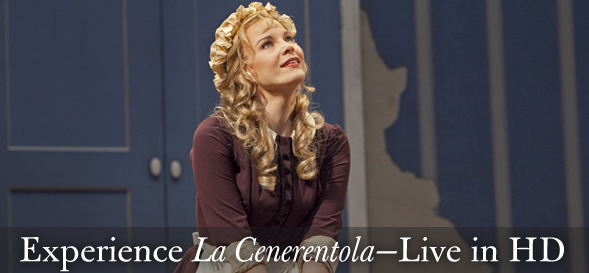
The first person on stage in this brilliant comedy was Australian soprano Rachelle Durkin as an ‘ugly sister’. The title role was sung by sensational young Latvian mezzo-soprano Elina Garanca (pictured above in Met publicity shot). She played the perfect ‘ash to cash’ heroine including the final magnificent ‘atonement’ tour-de-force Naqui all’affano. She has a smooth, large and exciting voice without a hint of strain over a wide range.

African American tenor Lawrence Brownlee was also excellent, along with Corbelli, Alberghini and Relyea as the fine bass-baritone roles in this hilarious romp. Corbelli as the Baron on this occasion had played Prince Ramiro in 1997 showing both his versatility and longevity.

Mounted for Cecilia Bartoli, the 1997 production by Cesare Lievi is a fantasy with many clever and amusing moments. Conductor Maurizio Bennini.

The evening was filmed by ‘floating’ cameras in the auditorium and I gather is to be broadcast ‘live’ this Saturday (31st May in Australia). These Met broadcasts have brought high quality opera to every corner of the world - and at much lower cost than sitting in the opera house itself. Subsequent DVDs become available at modest cost, putting opera within reach of almost anyone.

Comments by Andrew Byrne ..

For my original notes on the premiere of this production in 1997 see
http://www.redfernclinic.com/opera/critique/blog/1997/10/review-metropolitan-opera-premiere-of.php4

New York in springtime: http://ajbtravels.blogspot.com/2009/04/manhattan-in-spring-2009-wagner-and.html