Andrew's Opera was previously published at http://www.redfernclinic.com/

21 July, 2009

Manon Lescaut at the Sydney Opera House. Worth seeing!

Manon Lescaut - Giacomo Puccini. Thurs 16th July 2009 Sydney Opera House.

Lescaut - Teddy Tahu-Rhodes
Manon - Cheryl Barker
René Des Grieux - Jorge Lopez-Yanez
Geronte di Ravoir - Richard Alexander
c. Alexander Polianichko
d. Gale Edwards

Dear Colleagues,
The opera company has pulled it out of the bag again with another ‘adequate’ performance containing enough high points to keep the crowds happy. Mr Tahu-Rhodes is a great opera singer and he was crucial to the success of the piece. However, this casting decision left a great singer without as much as a famous aria and further, it allowed him to play another ‘scallywag’ role, hardly a great dramatic feat.

Each of the principal singers used their considerable resources, showing that grand opera is always a vocal marathon. The artists deal with it variously but there are some ground rules most agree on such as resting the day before a ‘big sing’.

Mr Lopez-Yanez eschewed some high notes initially but warmed into the role of the student Des Grieux. He looks the part, and moves emotionally from adolescence to manhood in Act I between his light ‘Tra voi belle’ to the profound ‘Donna non vidi mai’.

Ms Barker is an ‘immaculate’ singer and her attention to detail in this as every role was near flawless. More important perhaps were the couple of times when she has to ‘let it rip’ and take a risk. Each of these paid off handsomely and the audience received that thrill which opera is all about. Her impetuous phrasing of ‘Tu, tu, amore tu’ contrasted with the lilting ‘In quelle trine morbide’ and finally her woeful American denouement ‘Sola, perduta, abbandonata’. For some reason she was not made up to look like the debutante we know she can portray so well.

The set and setting for act one was rather clumsy to my taste being two large unhitched stage-coaches, neither being the one Mlle Lescaut arrived on, nor either the one the lovers fled in. It was unclear why so much activity happened atop these Cobb & Co cabooses.

Act two, by contrast, was a magnificent Parisian salon with large double doors (which seemed to lead to nowhere). Unlike Massenet’s slightly earlier 5 act version, Manon is already beyond her fling with young des Grieux and in the Parisian household of rich old Geronte. It appears that Puccini wished to present an original version of the events as well as a more concise adaptation of Prevost‘s story. Auber had also written an opera on the same story 30 years earlier.

Richard Alexander played an excellent Geronte. Dominica Matthews and Stephen Smith were also fine as madrigal singer and student.

The chorus and orchestra were up to their usual high standards.

Comments by Andrew Byrne ..

Opera blog: http://www.redfernclinic.com/opera/critique/blog/

12 July, 2009

Sydney Aida by Graeme Murphy - clever spectacle, adequate singing.

Aida. Sydney Opera House Tuesday 7th July 2009

Dear Colleagues,

The national company has a coup with Aida, one of the classic “ABC’s of Opera”. Along with Boheme and Carmen, these are the operas which impresarios ignore at their peril. After 12 years, Aida is back in Sydney. True to this maxim, there was hardly an empty seat for this Tuesday night opening. Dance supremo Graham Murphy has injected colour, light, movement and thought into the piece. A projected pyramid stands behind a flat illuminated triangle in which much of the intimate action takes place in this great work from 1871.

Other Egyptian motives included the Udjat eye of Horus, falcon wings, sphinx, columns with capitals, papyrus buds and lotus flowers. Some of these were literally cardboard cut-outs in black and white while others were enormous models. There was frequent projection of hieroglyphics onto the set, mostly of the Middle Kingdom classic written script rather than the more impressive coloured raised relief seen on Old Kingdom temples, obelisks and tombs. There were no pharaoh’s cartouches to tell us the period … although this story could have happened at almost any time in Egyptian history - except the 25th dynasty when the Ethiopians put their own southern pharaoh on the Egyptian throne.

American soprano Tamara Wilson sang the title role with flare and verve. She has an effortless and impeccable vocal production. However, at 27 years, this is still a young voice with many more life experiences to add further maturity and deeper expression.

Korean Mr Dongwon Shin passed the ultimate test for the tenor by conquering Celeste Aida. Unlike many tenors, he was more secure at the end than at the beginning. Remarkably, he sang the final words ‘… vicino al sol’ (‘close to the sun’) with a final diminuendo … and then repeated the words an octave lower! I have never heard it sung this way live or on recordings but I was told by one singer this is the way it was intended by Verdi. Mr Shin also maintained his vocal form both for forte contributions as in the big chorus scenes as well as in piano sections such as the final duet, O terra addio.

Ms Nikolic managed the role of Amneris, using her height and stage presence to support her vocal powers. With some clever devices, such as clipping initial notes, she brought herself up to this gigantean role. But Ms Nikolic did not dominate vocal proceedings as should probably be the case in this opera. Some say the opera should be called “Amneris”! It is a shame that the audience was not able to hear a truly great opera singer in this role as before (eg. Cullen, Elkins, Connell, Elms).

Michael Lewis acquitted himself well as Amonasro. This dramatically important role still seems somehow vocally unrewarding. He does not get any of the ‘hit’ tunes, and he is not involved in the opening or closing moments of the drama.

None of the other cast members really shone out … but none was inadequate either. While Mr Shin and Ms Wilson each had an artistic success, it seems intriguing that they were chosen ahead of the numerous Australian singers of comparable or better repute.

English Conductor Richard Armstrong seemed to keep a governor on the tempi, rather like the flow of the Nile. At times one longed for some variation in this measured movement. The AOB orchestra was back, making glorious music in their confined pit, having missed the season opening. They were replaced for the Purcell and Handel works by a baroque ensemble (and THAT is another story). The brass was particularly secure this time around and six of their members played ceremonial trumpets on stage in costume … only to be briefly flummoxed by the sliding ‘people-mover’ which jerked them to a precipitous halt in mid-bar.

The all-essential chorus was well prepared musically and they did major on-stage choreography including synchronised lines of lateral movement.

The production suffered from the dictum ‘when in doubt, add more’ with some aspects being overdone. The use of a conveyor belt at the front of the stage started during the introductory music with Aida gliding across the stage while admiring and caressing a silent and statuesque Radames. This paired moving footway was used for people going in both directions, individually and in groups. Unfortunately, this clever apparatus became a distraction and was overdone. Did they have to justify its installation or its inventor? Other motifs, tricks and devices were used with taste and due reserve. Wings of Horus, Anubis, Thoth and mummy masks were in evidence. The costumes were fittingly sumptuous, featuring leopard skins and gold raiment.

Dance was an integral part of this opera - as originally intended for the Paris opera style. Murphy presented the audience with 8 dancers performing a complex and varied routine of original and tasteful callisthenics at the appropriate musical and dramatic moments. This was very special choreography and superb dancing of the highest order. And it received as large a round of applause as any of the singing.

Like his Turandot, this Aida production by Graeme Murphy will serve the company well as long as they use adequate singers. Once upon a time this company had sufficient resources to mount two parallel star casts for this great work, very largely from their own ranks. Now they cannot muster one. Sign of the times?

Comments by Andrew Byrne ..

Opera blog: http://www.redfernclinic.com/opera/critique/blog/

New York in spring: http://ajbtravels.blogspot.com/

Shul notes: http://cantorialcrossoverculture.blogspot.com/

29 May, 2009

Il Trovatore at the Met: May 2009

Il Trovatore, Met Opera, Friday 8th May 2009 8pm.

Conductor - Riccardo Frizza
Manrico - Marco Berti
Count De Luna - Zeljko Lucic
Leonora - Hasmik Papian
Azucena - Mzia Nioradze
Ferrando - Burak Bilgili
Inez - Laura Vlasak Nolen

This David McVicar opera production was a major improvement to the Graham Vick fiasco of 2001 yet it still had its weaknesses and one shocking event which I believe is beyond any good taste (see below).

Utilising the full revolve of the Met stage, the opera opened, like Don Giovanni, to an enormous wall with attached ‘full-height’, vertiginous stairway-to-heaven with a landing and a door mid-way. This became the backbone of the various scenes, front, side and angled. The sets were not fully realistic but stylised using rough rocks, a portcullis, monastic items, crucifix, anvils and enormous outdoor stake for burning witches.

The cast members were all excellent with the artists warming into their roles and vocal confidence improved in each of the 4 acts. There was one intermission between act 2 and 3 which added to the task for the principal singers.

Ms Papian as Leonora paced herself carefully for this long role but was unassailable by the last act where her D’amor sull’ali rosee and Miserere were followed by the fiendish cabaletta ‘Tu vedrai che amore in terra’ to great acclaim. Ms Nioradze was strong and dramatically credible as the gypsy witch.

As Manrico Mr Berti was excellent. His almost impossible task of “Ah si ben mio ..”, followed by “Di quella pira” was well executed (one verse of the latter). And there were cheers all round at his capable and exciting terminal high C.

At one point Mr Lucic as De Luna pulls out his sword, grasps it with his left hand and runs the blade through his clenched fingers to the sight of spurting blood which then haemorrhages visibly for the remainder of the scene. On his exit he wipes a red stain onto the castle wall. I found the unexpected episode to be shocking and the audience seemed to gasp and recoil as it was done. It was most distracting and unnecessary, bearing little relation to the story-line (such as it is). If it derived from the libretto (which I doubt) it also distracted from the words, music and subtitles. Blood brothers may be one thing, but self mutilation on stage is quite another.

Lucic’s ‘Il balen’ was a high point vocally along with the chorus and cabaletta following.

Mr Bilgili and Ms Nolen as Ferrando and Inez both had substantial and important voices which would have eclipsed lesser singers in the major roles.

The anvil chorus deserves special commendation, being the only realistic anvil use on stage I have seen. The chorus members were at one, strong-voiced and sympathetic to the piece. By chance the same week the Met was also performing the only other anvil song I know from opera. The first act of Wagner’s Siegfried makes quite a different, energetic workman‘s song - first performed 20 years after Verdi’s version.

Overall a very enjoyable performance … but a production which shows just how difficult it is to present this opera without major breaks and clunky scene changes. I vote for two or even three intermissions as Verdi intended.

Comments by Andrew Byrne ..

08 May, 2009

Cenerentola at the Met: May 2009


Cenerentola (Cinderella) Rossini Wed 6th May ‘09. The Metropolitan Opera, New York City.

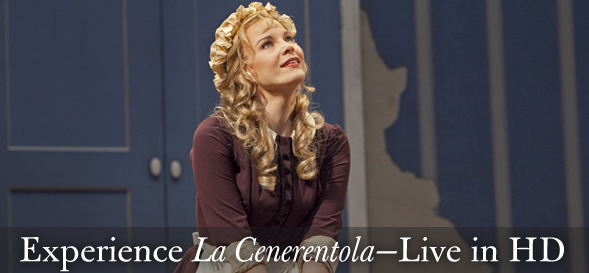
The first person on stage in this brilliant comedy was Australian soprano Rachelle Durkin as an ‘ugly sister’. The title role was sung by sensational young Latvian mezzo-soprano Elina Garanca (pictured above in Met publicity shot). She played the perfect ‘ash to cash’ heroine including the final magnificent ‘atonement’ tour-de-force Naqui all’affano. She has a smooth, large and exciting voice without a hint of strain over a wide range.

African American tenor Lawrence Brownlee was also excellent, along with Corbelli, Alberghini and Relyea as the fine bass-baritone roles in this hilarious romp. Corbelli as the Baron on this occasion had played Prince Ramiro in 1997 showing both his versatility and longevity.

Mounted for Cecilia Bartoli, the 1997 production by Cesare Lievi is a fantasy with many clever and amusing moments. Conductor Maurizio Bennini.

The evening was filmed by ‘floating’ cameras in the auditorium and I gather is to be broadcast ‘live’ this Saturday (31st May in Australia). These Met broadcasts have brought high quality opera to every corner of the world - and at much lower cost than sitting in the opera house itself. Subsequent DVDs become available at modest cost, putting opera within reach of almost anyone.

Comments by Andrew Byrne ..

For my original notes on the premiere of this production in 1997 see
http://www.redfernclinic.com/opera/critique/blog/1997/10/review-metropolitan-opera-premiere-of.php4

New York in springtime: http://ajbtravels.blogspot.com/2009/04/manhattan-in-spring-2009-wagner-and.html

The Ring at the Met April/May 2009

The Ring operas Metropolitan Opera, New York. Starting on Monday 26th April 2009 Brief notes.

Das Rheingold was a triumph in almost every respect. The cast was led by German bass baritone Albert Dohmen as Wotan. His voice is accurate and warm with a strong high range as well as a reasonable low extension. He did not tire in the three operas whose drama Wotan the Wanderer fashions by his arrogance and miscalculations.

This may be the last time Domingo as Siegmund could or should do this ‘handsome teenager’ role in Walkure. But people may have said that 4 years ago when he did the same role in the same house, and he is still incredible. No reservations, not even the slightest vocally even though his old age naturally shows up the closer one sits. Unfortunately, he became ill during the Walkure of the following week and had to be replaced by Gary Lehman before the Wintersturm aria.

Rene Pape did the rather unrewarding role of Hunding while Adrianne Pieczonka was his beautiful and effective Sieglinde.

Katarina Dalayman is a glorious Brunnhilde. For absolutely no apparent reason she was loudly booed by a single man in the upper part of the theater and everyone (including the singer) seemed shocked. She had sung superbly. Her voice has a controlled hard steely edge just on occasions when she really wants to use it, such as some sopranos may have in a completely uncontrolled manner. So she has gifts, like a trill (and she’s got that too!), which just put her in her own league above the ordinary. An excellent Linda Watson did the Siegfried Brunnhilde for some reason - perhaps Ms Dalayman was too thin.

Christian Franz as Siegfried was excellent and did not appear to tire up to his untimely but rather necessary death. The ‘woofle’ heard from him on the broadcast the week before was almost completely absent in the theater on Saturday to my ear.

The cast of the whole Ring is balanced and nobody let the side down. Equally, no single singer particularly dominated either vocally or by taking the dramatic lime-light. Orchestra, soloists, chorus were all in top form. Maestro James Levine received multiple rapturous receptions at each act and final curtain.

This production of the Ring by Otto Schenk is now a museum piece. Like the liner QEII, it is 19th century technology and simply cannot be continued indefinitely. It has scrims, pulleys, models, back-lighting, anvils and every trick of the stage … but is now dated and in some cases tatty and nearing obsolescence. The scrim front paired curtains still failed to operate properly but it hardly mattered. There were a few clunks and squeaks between scenes (but for all I know these may have been present 20 years ago). To my best knowledge this production follows most closely to what Wagner ordered in his very detailed staging instructions. This includes underwater simulations, people disappearing on stage, transmutations, dragons being killed, smelting, rope binding, cooking, etc, etc. I was told by a Wagner expert that only Vienna in living memory has done comparable Rhine operas.

I have been fortunate enough to see this in 1992, 2000, 2004 and 2009 but this is the end of the line, sad to tell. A preview of the new proposed Met Ring on Tuesday 5th May was cancelled for some reason, hence little more is known about it.

I think that the Met is probably the only opera company to make money out of Wagner. The huge capacity opera house with excellent acoustics are factors. In their lead up, the company does two or three weekday performances of the two more popular operas, Rheingold and Walkure. The ‘first cycle’ is broadcast series of Saturday matinees over 5 weeks. These are broadcast live internationally (except Australia, of course). The company then does two complete cycles of Mon, Tues, Thurs and Sat of Rheingold, Walkure, Siegfried and Gotterdammerung. Tickets were available for every performance of this particular cycle. Top seats were $400 but there were many seats available for prices down to $65 with standing room half that only available on the week of the operas. This is a sign of the times which are affecting New York as much or more. Restaurants, shops and businesses that have been going for generations are closing down. Hickey Freeman, Balducci, City Opera, OONY, Carnegie Hall have all been affected with ‘bail-out’ specials offered by many who are still trading.

Comments by Andrew Byrne ..

15 April, 2009

Crikey commentary on languishing opera company.

http://www.crikey.com.au/2008/09/08/letter-to-opera-australia/

Opera Australia in shifty AGM lock-down

Our national opera company continues to behave like a naughty adolescent instead of the mature adult of 50 which it is. For the past few years one rule after another has been broken and nobody is holding the present management to account.

Uniquely, this year’s OA Annual General Meeting will be in Melbourne. No problem with that, but by the time it was announced, it was too late for Victorian subscribers to register. Also, many others from interstate will be unable to attend due to the awkward timing of 3pm on “Easter” Thursday April 9.

For the first time in a decade I did not received a notice about the AGM. I called the company to be told that I am no longer a voting “member”, despite fulfilling the simple criteria of contributing $160 to the company in a given year. I donate a modest sum each year and have two subscriptions. It may be that I did not tick the appropriate box or filled out the right form with my subscription or donations. Whatever, other subscribers and supporters may have done likewise. I now have the application forms but it is too late to register for this year’s meeting. Touché!

I discussed this matter with a current company insider. He also found it particularly odd, especially for a company supposedly open to public scrutiny and currently in the process of finding new artistic and musical administrators.

One wonders if holding a meeting away from head office at short notice on the Easter break is a sign of a “closed shop”. From various blogs and talk-back radio we know that there are some opera subscribers who are still keen to attend the AGM and possibly propose motions from the floor. Good luck, I say!

Back to the stage: like marathon runners, opera singers and their teachers have long held that sufficient rest is needed to recuperate from a “big sing” for their own health and vocal longevity. Most of the great operatic roles are in this category and famous singers of history would rarely do more than two such performances per week. To assist with the bottom line, Opera Australia has obliged singers to perform with just one day’s break on many occasions in the past few seasons. Some instances were of a Thursday evening performance and then a Saturday matinee, making even less than 48 hours between shows, a risk to tension and tonsil alike.

The company’s “Mission Statement” makes it clear that the company is to be involved (only) in opera and opera singers, purveying “opera of excellence that excites audiences and develops and sustains the art form in Australia”. For this it receives substantial government funding both State and Federal. There is no mention of musical comedy in the Mission Statement.

The Sydney opera gala opening for 2008 was My Fair Lady which ran for one of the longest seasons ever (in three different theatres!). The show did not employ many opera singers, nor did it fulfil the obligations of the mission statement. While the company does Gilbert and Sullivan operettas every few years at the end of the season, we now find musical comedy as a major activity, clearly at the expense of mainstream opera. Other companies perform high quality musical comedies but there are few alternative providers of opera. Tax payers might well ask where their funds are going. While the company justifies this by box office receipts, they could also install poker machines in the Green Room with the same outcome to profits.

The final paragraph of the company’s Mission Statement says that they will: “Be rigorous in self-examination and open to informed, outside evaluation of both our successes and failures”. I can see no sign of this from management or board.

Until there is a catharsis, absolution and re-statement of intention from management I for one will remain sceptical about this board deciding on the new musical and artistic administrators. It is more like a war cabinet, delightful and open individually perhaps, but secretive and closed to its public as a board.

One wishes the company well in the search for new leadership. There is still much to admire aboard this rudderless ship. One guide from this perplexed subscriber might be that rather than a profit, this company needs a prophet to lead it out of its current woes. An open discussion at a well attended AGM would do no harm either.


Dr Byrne runs an addiction clinic in Redfern, NSW.

22 March, 2009

Werther and Butterfly at Sydney Opera House.

‘Werther’ by Massenet at Sydney Opera House Thurs 12th March 2009
Madame Butterfly long summer/autumn season continued on 16th March.

Dear readers,

Werther is being performed with a marvellous cast in Sydney for the next week or so and Massenet fans should not miss out. The opening played to a half empty house on Thursday in stark contrast to Monday’s excellent performance of Madame Butterfly which was packed out.

An expert on French opera wrote that Werther is ‘one of Massenet’s finest creations’ and that the title role a great part for a truly gifted tenor … and apparently many famous tenors claimed it as one of their favourites.

Still a Werther novice, I managed to raise a few goose bumps but nothing to compare with Manon … which may be just unfamiliarity and ignorance of the genre on my part.

This Elijah Moshinsky production is very clever (a shame his name is spelt Moshinksy in the cast list). The opera opened with a huge silk sheet covering almost everything on stage: tables, chairs, bicycle, toys, fence, etc. As the prelude progressed it was gradually pulled away, ‘sucked’ into a hole in the middle of the stage! A weird and wonderful way to expose the scena of bright green grass, garden furniture, classic entrance architrave, etcetera.

Aldo Di Toro, a graduate of WA Conservatorium, played the title role with flair and confidence. He was little short of magnificent in both vocal lines and characterisation as well as cutting a fine figure on stage. His only great pot-boiler, “Pourquoi me reveiller” was indeed moving (and the only part of the opera I really warm to). After shooting himself in the next scene the drama seemed interminable … but of course others will disagree and want it even longer. I compare it with the (female) death scene of Manon which I once found boring but now adore every note!

Canadian mezzo-soprano Michele Losier was engaged at the last minute as Charlotte since Pamela Helen Steven had withdrawn after the tragic death of her husband, Richard Hickox. Ms Losier was very fine, saving the best to the last act. It is still odd that an Australian mezzo-sopranos was not asked to do the role (Kirsti Harms had a major success in the last run). Soprano Sarah Crane as Sophie was also well cast in her couple of memorable scenes (Taryn Fiebig was originally billed to do the role). The supporting and character roles were also excellent, notably Stephen Smith as Schmidt and Stephen Bennett as Le Bailli.

The orchestra was conducted by Emmanuel Plasson, a most didactic, athletic maestro who nearly danced on his podium at times.

The result was very high quality opera yet one looked around the auditorium with regret considering all the empty seats. It is clear that Sydney only has a small audience for these lesser known operas. People who are keen on these ‘connoisseur’ pieces will travel for such performances. But nobody is on a limitless budget and so to have Lady Macbeth of Mtsensk at the same time may be asking too much for this ‘niche’ audience. Some must have agonised about which to see, especially when neither sadly were being televised or put onto video, as far as I know. The same was true of Billy Budd and Makropulos Case being done simultaneously last year, a financial disaster one suspects at the same time as triumphs artistically, but not committed to video which is yet another fault of the current management and board who seem to believe that nothing matters but the bottom line.

Just as there are more Papaganos in this world than Taminos … so there is a large base of subscribers who pay top money for what one might call the “DEF” of opera or the middle ranking or timelessly popular operas: Tosca, Rigoletto, Trovatore, Traviata, Pearlfishers, Cav/Pag, Faust, Cosi, Don Pasquale, Flying Dutchman, Barber, Cenerentola, (there are 25-50 more in this category). There is less interest in the rarer master-pieces (including Britten, Janacek, R. Strauss, etc) despite their undoubted success artistically … even if savants wax lyrical about the details … these are works which have rarely filled opera houses for very long.

It is still a privilege to be able to attend a range of such operas, faults and all, at some distance from the rest of the world with a relatively small population base as Sydney and Melbourne. It is to be hoped that the new artistic and musical director of the company will be able to bring more balance and cohesion to things. For a start, the company needs to follow some basic rules of the theatre. The second performance of Werther was a hair-raising 48 hours after the opening instead of 72, the traditional minimum for grand opera. No excuses!

Madama Butterfly - Monday 16th March 2009 - Sydney Opera House.

I had wanted to hear the second cast of the Puccini only to find that Antoinette Halloran had finished her run and Cheryl Barker was back as Cio-cio-san 10 weeks later in this long season. She did not disappoint, after a rather shaky start in which her high notes developed an ugly beat (Joan Sutherland used to do the same), she then warmed up to give a memorable dramatic delivery. Rosario La Spina was Pinkerton. He appears to have put on more weight but his glorious voice is still perfect for this part. I am getting goose-bumps just writing about it. His Addio fiorito asil was sensational.

Catherine Carby played a suitably mournful Suzuki. Barry Ryan was an adequate ambassador, also doleful. Particularly moving was Andrew Jones as Yamadori. It is nice to hear a large, beautiful, well projected voice in someone who can act as well.

This opera is indeed a ‘recession buster’. After a half empty Thursday night gala opening of Werther last week we now had a packed and enthusiastic house on a non-subscription Monday night. I did not recognise one single face in the theatre or foyers or bars or taxi queue … which is unusual for ‘small-town’ Sydney. It may indicate a new or different audience. There was no cruise liner in dock and most looked like relaxed locals, out for the night. I suppose regular opera goers who wanted to hear Butterfly had already had their many chances. And there is still another performance next Monday.

Comments by Andrew Byrne ..
~~~~~~~~~~~~~~~~~~~~~~~~~~~~~~~~~~~~~~~~~~~~~
Dr Andrew Byrne MB BS (Syd) FAChAM (RACP)
Dependency Medicine,
75 Redfern Street, Redfern,
New South Wales, 2016, Australia
Email - ajbyrne@ozemail.com.au
Tel (61 - 2) 9319 5524 Fax 9318 0631
~~~~~~~~~~~~~~~~~~~~~~~~~~~~~~~~~~~~~~~~~~~~~
Clinic web page: http://www.redfernclinic.com/
Concord Seminar blog: http://concorddependency.blogspot.com/
Opera blog: http://www.redfernclinic.com/opera/critique/blog/2009/01/resplendent-madame-butterfly-at-sydney.php4

07 March, 2009

Lady Macbeth of Mtsensk - Sydney Opera House 3 March 09.

Lady Macbeth of Mtsensk - Sydney Opera House Tuesday 3rd March 2009.

Katerina - Susan Bullock
Zinovy - David Corcoran
Boris - John Wegner
Sergei - Simon O’Neill
Orthodox Priest - Gennadi Dubinsky
Police Chief - Warwick Fyfe
Drunkard - Kanen Breen
Convict - Jud Arthur
Female convict/Cook - Jacqueline Dark
Sergeant - Richard Alexander

Conductor - Richard Armstrong
Director - Francesca Zambello
Chorus master - Michael Black
First Violin - Aubrey Murphy

Music - Dmitry Shostakovich
Libretto by Alexander Preis and the composer
In English, with titles.

Dear Colleagues,

This re-staging was one of the most raunchy, “in-your-face” musical-vocal dramas I have ever seen. It was also one of the best cast operas we have seen from the national company. Clearly the company management knew what it was doing when aiming at excellence. In a huge cast, they chose high quality international stars as well as local talent incredibly well matched to the stage and vocal requirements. Kanen Breen as the frail drunkard almost stole the show in his brilliant scene and sequel. Warwick Fyfe likewise as police commissioner took control with his vocal power and rough edges, perfectly suited to the role.

Russian born bass Gennadi Dubinsky sang and acted a creditable Orthodox priest, compulsively lying to his flock as priests do. I gather this talented man has been hidden as an understudy. The company seems not to give their ‘cover’ singers exposure like the Met and elsewhere. And sometimes the ‘covers’ are better than the engaged performers.

The major stars of the night were tenor Simon O’Neill and soprano Susan Bullock. With these incredibly taxing vocal roles they both also acted creditably in what was everything from rape, assault, conspiracy, double murder, sex on stage and final denouement of suicide and abandonment in Siberia. The sex may have been simulated … but in three or more Karma Sutra positions in an excruciating burst of energy. The orchestral accompaniment included double bassoon and tuba in over-drive along with rhythmic cadences, hasty progressions and hesitations followed by major plosive ejaculations. There was some brief tenderness but only very brief.

Ms Bullock has a large, focussed and radiant soprano voice. She has sung Brunhilde at Covent Garden. Her portrayal here was highly effective as she looked sexy and revealed the longings of a neglected young wife.

The philandering lover, Simon O’Neill, although cutting an imposing figure, sang and acted brilliantly. His voice is penetrating, accurate and beautiful. His CV is staggering, including Florestan, Siegmund and Parsifal.

John Wegner played the father in law who is eventually killed by rat bait in the mushrooms after gratuitous taunts and violence. As always, he was vocally and dramatically exemplary.

Shostakovich chose a dour and depressing story for his shocking opera. Almost everything represented if is drab and boring. The opera covered much that is negative in life, starting with just one precipitated extra-marital fling. We were made to feel the cold, hunger, boredom, crowd anger, filth, alcoholism, violence, loveless marriage, hateful in-laws and destitution. For me at least, balancing beauty was hard to find. The sets were appropriately drab: white dirty bathroom tiles, plastic props, single strip fluorescent lights. The clothing was all dreary. Yet this undoubted masterpiece is lost on me (and a lot of patrons who did not return after the intermission).

There was some contrast with the final death camp scene including a rousing chorus of prisoners and some of the brass sections from the auditorium raised goose bumps on even this crusty subscriber’s flesh. The chorus, orchestra and conductor deserve the highest acclaim in this challenging and unfamiliar work.

The opera company management assembled all the elements which make for truly great opera. It was the second time recently that this was done (Billy Budd was the other). Like my criticism at that time, it is a great tragedy for Shostakovich fans that this will apparently not be televised or videoed. It is unlikely that such a strong cast and production will be assembled anywhere in the world for a very long time. In stark contrast to this world-class opera production, most of the other season operas have glaring deficits with few international standard star artists. This opera had three or four (or five if you include the conductor).

The clear ‘quality bias’ of the company towards the 20th century repertoire (eg. Makropulos Case and Arabella - which were also excellent) is a boon for opera goers who like that sort of thing. However, as a result many standard repertory works are performed on a mediocre level and others displaced altogether by long seasons of over-exposed popular works (La Boheme, Carmen, Butterfly and My Fair Lady). In this way, subscribers may have been deprived of choices (and opera singers of jobs, experience and exposure). There is also a dearth of star performers in these works, most clearly exemplified in the embarrassing La Boheme season which was shown on “ABCTV-2”, a station some sets don’t even receive. In the circumstances that might be as well.

Comments by Andrew Byrne ..

22 February, 2009

Joan Sutherland Society concert at St Pauls Burwood.

Lucia di Lammermoor 50th Anniversary Concert. Sunday 15th February 2009 2pm. St Paul’s Church, Burwood.

Dear Reader,

Doug Cremer and the Joan Sutherland Society have done themselves proud with an afternoon of great singing at St Paul's Church in the presence of some divas of the past and the present.

Lauris Elms, Morag Beaton, Malcolm Donnelly and Amanda Thane were in the audience to support the younger singers in an adventurous program. There were 2 Lieder excerpts (Brahms), grand opera (Bizet, Donizetti, Verdi, Wagner) with two Italian canzone (Musica proibita; Cor ingrato) and three items from light operas/musicals (If I were a rich man; Gendames' duet; Anything you can do). The afternoon finished with the rather rude English folk song 'Oliver Cromwell' which ends "If you want any more you can sing it yourself!"

The afternoon was compered by tenor Glenn Winslade. Sharolyn Kimmorley played the ivories with aplomb as ever. I hope she is never taken for granted. We were reminded that Ms Kimmorley was belatedly honoured in this year’s Australia Day awards for her services to singing and singers. With ease she straddled the different styles, solos, duets and two large concerted pieces, turning pages on her own.

The hit of the afternoon for me was Daniel Sumegi singing Banquo's aria from 'that opera'. It shows off his deep, expressive voice in a more dynamic way than in Mozart. As in Nabucco, he reaches the heights and limits of his fach ... and the genre. Then, to show his versatility he joined in the Lucia sextet, “We run them in” duet (with John Wegner) and finally the "I can do anything" duet (with Domenica Matthews).

Mr Wegner was splendid in ‘If I were a rich man’ from Fiddler on the Roof as well as doing a great rendition of Escamillo's difficult Toreador aria.

Michael Lewis and his wife Nicole Youl sang some fine Brahms to kick off the program, first reading the English translations for our benefit which was most helpful. Lewis then sang the first act baritone aria from Lucia (‘Cruda funesta’) including the fiendishly difficult cabaletta.

Ms Youl sang Dich teure Halle with confidence, strength and that edge Wagnerian sopranos need. Perhaps this is the direction she is headed after the current excellent Santuzzas finished up this weekend.

In the absence of the indisposed Mr Andrew Goodwin, Christopher Hillier, a baritone in the OA chorus, stood in at short notice, singing a very fine 'Bella si come un angelo' from Don Pasquale as well as Musica proibita. Both were class acts indeed for his light and pleasant voice.

Stephen Smith, with his indelible Pacific smile sang 'Una furtiva lagrima', followed in the second half by Cor Ingrato. He also featured prominently in the sextet from Lucia. After a great success as a very energetic Beppe in Pagliacci this season, he is a talent to watch.

Domenica Matthews and Teresa la Rocca did the program's first opera excerpt, Hoffmann's famous 'Barcarolle'. They both also sang in the Lucia sextet ‘Che mi freni’ while Ms la Rocca sang a creditable ‘E strano .. Ah forse lui .. Sempre Libera’ from La Traviata. She tackled the hard options on both, each at her considerable and exciting limits.

This concert was in memory of Deborah Riedel who died recently after a long battle with cancer. The speaker reminded us of her magnificent Norma duet at a previous St Paul’s concert with Fiona Janes as Adalgesa.

We were told to look forward to the next event in which it is hoped Dame Joan and Richard Bonynge may ajudicate the most deserving young singers.

Unsurprisingly there was no (apparent) representative of the opera company present - but that is just what happens in a company bereft of direction. At a recent performance of Cav/Pag I attended there was no accompanist for the Siciliana which Dennis O'Neill bravely sang in its entirety alone, happily ending the long aria on the right note for the massive orchestral segue. Does the company have any standards? The singing was very fine yet the house was not well sold and there is a feeling of inertia rather than enthusiasm. Let's hope there is a renaissance under new management, and soon.

Comments by Andrew Byrne.

Clinic web page: http://www.redfernclinic.com/#news

Opera blog: http://www.redfernclinic.com/opera/critique/blog/2009/01/resplendent-madame-butterfly-at-sydney.php4

28 January, 2009

The Magic Flute. Sydney Opera House. Thursday 22nd Jan 2009. Don't miss it!

The Magic Flute. Sydney Opera House. 7.30pm Thursday 22nd Jan 2009.

Dear Colleagues,

This David Freeman production is a smash hit for the Sydney Summer Festival and I recommend everyone should consider getting a ticket if they like that sort of thing or if they are new to Flute. Don’t be put off by the price since tickets are freely available from $42 mid-week … in restricted view positions in the middle loges - Y / B which were empty on opening night. While I find this opera (or ‘singspiel’ more correctly) has long dull patches, it is still a favourite with audiences down the ages. And it contains some of the most glorious arias ever written, linked as they are by a somewhat tiresome text akin to a pantomime or moral play. Glyndebourne had the right idea 20 years ago by cutting all the talking!

My comments are incomplete as I had to leave shortly after the second Queen of Night’s aria - which was brilliantly sung by Emma Pearson. She was indeed a splendid Queen of Night in every respect. After her stratospheric second aria she received a roar of cheers and acclaim from the audience. Her vocal and dramatic performance had been dazzling indeed - including her first act O zittre nicht which was sung sitting in an oversized alabaster illuminated quarter moon suspended by wires high above the stage. She deserves risk money!

Daniel Sumegi as Sarastro sings the haunting In diesen heil'gen Hallen which has some of the lowest notes written. The previous aria had the highest! Mozart must have been a mean machine … or else he disliked singers!

It seemed curious that Emma Matthews was playing Pamina again since she is so ideally suited to the great coloratura roles like Lucia. Marilyn Horne said in a master class that once a soprano had the fiendishly difficult Ach! Ich fuhls ‘in the voice’, the rest of this role was a ‘walk-over’. Matthews’ Konstanze in Seraglio two years ago was excellent and perfectly suited to her remarkably agile voice. She could also sing the Queen of Night I imagine.

Warwick Fyfe as the bird man was a bit ‘rough and ready’ and the dialogue he was given sounded ‘Ocker’ and even embarrassing at times. He even came on stage with his personal barbecue and tinnies. And he has a large voice and sings in tune.

Kanen Breen was Monostatos and this is possibly the best thing I have seen/heard him do. And his mostly original dialogue, being quite poignant with the new white house incumbent this past week. Stephen Bennett is back as an excellent Masonic mentor, as was his priestly partner in Graham MacFarlane.

Mr Goodwin makes a fine Tamino, a difficult role somewhere between cantor singing and performing in a radio play. The high point for me is the famous portrait aria.

Ollivier-Phillipe Cuneo conducted confidently and the brass players did themselves proud on this occasion.

The clever and quirky production looks to be set in the Amazon jungle … vines and unexpected animals/birds everywhere in dark shadows. Other sections seem to take place in a giant pietra dura jewel box. As valid as any other interpretation, I suppose, considering it is a fantasy work … and Schikaneder would probably be delighted (the impresario also played Papageno at the opening). It is amazing to know that this was written in the same period as La Clemenza di Tito in the final months of Mozart’s short but productive life.

Comments by Andrew Byrne ..

Clinic web page: http://www.redfernclinic.com/#news

Opera blog: http://www.redfernclinic.com/opera/critique/blog/2009/01/resplendent-madame-butterfly-at-sydney.php4

New York in 2008: http://ajbtravels.blogspot.com/

15 January, 2009

Cav and Pag compete favourably with Sydney Festival.

Cavalleria Rusticana and I Pagliacci at the Sydney Opera House Sat 10th Jan 2009

Cavalleria Rusticana - Mascagni
Turiddù - Dennis O’Neill
Santuzza - Nicole Youl
Mama Lucia - Jaqueline Dark
Alfio - Jonathan Summers
Lola - Domenica Matthews

I Pagliacci - Leoncavallo
Tonio - Jonathan Summers
Canio - Dennis O’Neill
Nedda - Amelia Farrugia
Peppe - Stephen Smith
Silvio - José Carbo
Directed by Andrew Sinclair
Sets by Shaun Gurton
Conductor Andrea Licata

Dear Colleagues,

Renowned baritone Jonathan Summers provided the dramatic and to some extent the vocal focus for this pair of immaculate thriller operas. He demonstrated a staggering depth of character, volume and texture of vocal line and showed what it is to be a star of the operatic stage. At the end of his moving prologue aria “Si puo?“ he nailed an A flat which seemed unassailable.

His tenor counterpart in both operas was Welshman Dennis O’Neill who showed equal mastery of the art. Again, there were fast, slow, high and low to show off his prodigious talents, nowhere more so than in the clown’s dressing-room aria, ‘Vesti la giubba’.

Ms Youl was ideally suited to the role of Santuzza. Her ‘Regina cœli’ and ‘Ineggiamo’ scene was high art indeed with the freeze/flashback very cleverly staged using blacked out rear and fly lighting with linear precision indicating pews in a church. The return to the village square and conversation between the excommunicated and mother in law seemingly seamless.

Ms Farrugia played a suitable Nedda and had all it takes dramatically and vocally even though the role is unlike her usual (everyone has to be adaptable in this day and age). Ms Domenica Matthews played a sexy and detached Lola.

Village lover Silvio was played brilliantly by Jose Carbo. This smaller role is often left to a lesser talent but Mr Carbo looked the part in white poplin, his voice coming over as confident, even and large, befitting his engagement at La Scala this year.

I had forgotten that after the scripted bloodshed, Canio stabs himself at the end of I Pagliacci which was an added dramatic shock to an action-packed evening of opera.

Mr Licata conducted with gusto and flair with all points going to the woodwinds and the prominent scoring especially for flute and bassoon. I must say that again there were jarring noises from the brass, evidently the trumpet section on several occasions and one wonders if there is a problem there needing attention.

I note from the new season schedule that the company is still calling on singers to do major roles with only one day’s break on occasions. Nobody in the company seems to heed history, medical and occupational health experts, singing teachers or agents. The company gives … and the company takes away. It is like the editor’s decision being so very final. If our singers had a strong union like the orchestra this would never have been allowed to happen, at least not without serious danger money being paid.

It is hard to imagine that the opera company management has such entrenched problems when opera of this high standard is being put on. Yet operas are scheduled 2 to 3 years ahead of time … and the first two operas of the season are repeats of standard repertoire using known talents with little if any ‘risk’ or exposure.

Following the sudden death of maestro Richard Hickox in November, another untimely and tragic loss this past week will also impact upon opera in Australia with the passing of soprano Deborah Riedel after a long battle with cancer. Our sympathies and thoughts go to her family and friends at this difficult time.

Ms Riedel, 50, had prodigious talents in both dramatic and coloratura roles. Her stage skills were well honed and she had consistently favourable notices in her formidable international career. She sang in many of the great opera houses and worked with some of the world’s top talents including Jose Carreras, Joan Sutherland and Richard Bonynge. Despite this, and along with numerous other top Australian artists, Ms Riedel was engaged less and less by the national company in favour of a small group of younger, ‘safer’ and perhaps more amenable female singers. The opera company’s initial media release (since corrected) had Ms Riedel performing in the 50th anniversary gala concert when in fact she was in the audience. It is all very sad. Rest in peace. The funeral is on Friday morning.

Comments by Andrew Byrne ..

Clinic web page: http://www.redfernclinic.com/#news

03 January, 2009

Resplendent Madame Butterfly at Sydney Opera House.

Madame Butterfly - Sydney Opera House Tuesday 30th December 2008, 7.30pm.

Cio-cio-san - Cheryl Barker
Pinkerton - Julian Gavin
Sharpless - Barry Ryan
Suzuki - Catherine Carby
Cond. - Shao-Chia Lu

Dear Colleagues,

This performance of Butterfly was a triumph in every way. It was a worthy outing of Puccini’s masterpiece and an important psychological threshold for a company under stress from several angles, culminating in the sudden death of Maestro Richard Hickox last month in the UK.

Ms Barker is unrivalled in Australia today as Cio-cio-san. While she did this role in 1997 with charm and poise, the intervening years have not diminished her powers. Puccini’s heroine is one of the most difficult operatic characters, needing to look like a delicate Japanese teenager yet sing like a Walkurie!

Returned Australian Julian Gavin is every bit of the international star tenor and his Pinkerton is worthy indeed. The voice is well supported and secure up to a resplendent top. His dramatic presence is such that he was given some ‘in character’ boos at the end. Puccini and his librettists made sure that this role was the ultimate insult for American foreign policy … some things never change … but this IS opera, after all!

Barry Ryan looks and sounds like a competent comprimario singer which is just fine for an embassy delegate, especially one without an aria. The other brief but important roles were also well cast.

Not since the Sutherland days had I seen virtually every single seat occupied at the Sydney Opera House. Balcony boxes, rear rows and standing room were all occupied … and few if any tickets appeared to have been given away, a common practice last season. On the other hand, an ambitious season of 23 performances may be stretching the opera market beyond its boundaries. Also, the season opening, usually the 2nd or 3rd of January, had been advanced by 4 days, altering the plans of all Gala patrons who renewed. This strategy appears to have paid off so far. Those wishing to hear the vocal and dramatic chemistry between Julian Gavin and Ms Barker will have to be quick as they only sing together for another 5 performances with the season continuing for three full months (with cast changes).

The orchestra under Taiwanese Mr Lu played well but we seem to have to tolerate frequent blurts and off pitch notes from the brass section, over which Mr Lu probably has little control.

I personally find this production irritating and unsympathetic. It seems to be a slowed down version of Miss Saigon which has the same story line. Yet it is popular with the crowds and that is what matters these days.

Comments by Andrew Byrne ..
~~~~~~~~~~~~~~~~~~~~~~~~~~~~~~~~~~~~~~~~~~~~~
Dr Andrew Byrne MB BS (Syd) FAChAM (RACP)
Dependency Medicine,
75 Redfern Street, Redfern,
New South Wales, 2016, Australia
Email - ajbyrne@ozemail.com.au
Tel (61 - 2) 9319 5524 Fax 9318 0631
~~~~~~~~~~~~~~~~~~~~~~~~~~~~~~~~~~~~~~~~~~~~~

Clinic web page: http://www.redfernclinic.com/
Opera blog: http://www.redfernclinic.com/opera/critique/blog/
New York in 2008: http://ajbtravels.blogspot.com/
New York in 1922: http://bpresent.com/harry/code/10b_bowery.php
Travel log: http://www.redfernclinic.com/c/2007/10/lord-howe-island-naturalists.php4
Vincent Dole in Nepal Diary: http://vincentdolehimalaya.blogspot.com/
Old photos of Sand Souci: http://sanssouciphotos.blogspot.com/

Every theatre is an insane asylum, but an opera theatre is the ward for the incurables.

15 December, 2008

Manon from Berlin on DVD - magic night at the opera, at home!

Manon by Massenet. Berlin Staatsoper April/May 2007. Deutsche Grammophon DVD of live performance.

Manon - Anna Netrebko
Chevalier des Grieux - Rolando Villazon
Comte des Grieux - Christof Fisch Esser
Lescaut - Alfredo Daza
Guillot de Morfontaine - Remy Corazza
Bretigny – Arttu Kataja
Grisettes – Hanan Alattar, Gal James, Silvia de la Muela
Innkeeper – Matthias Vieweg

Conductor: Daniel Barenboim
Director: Vincent Paterson
Stage design: Johannes Leiacker
Costumes: Susan Hilferty
Chorus and orchestra of Staatsoper, Unter den Linden, Berlin.


Dear Colleagues,

I am still reeling from the beauty and sheer class of this magnificent live opera from Berlin. It shows just what can be done with talent, imagination and a true operatic masterpiece. I have not enjoyed an opera so much for years, live or recorded! Second and third viewings have yielded even more pleasures in a clever, up-dated and sympathetic production with top rate singers, dancers, actors and musicians. The character development, main love theme, side stories and final disastrous denouement are all absolutely captivating.

The opera seems perfectly credible in the mid 20th century as long as one takes Manon’s capital crime as more than just cohabiting (there is an implication that she has stolen money from Guillot).

The opera opens in a bustling grand railway concourse where Manon emerges from a huge crowd to be first greeted and then lectured by her cousin soldier Lescaut. We also meet the scheming veteran Guillot who tries to befriend the young lady while Lescaut is away briefly. Next, during a slightly longer absence at the barracks, a more intense and yet equally hopeless liaison commences.

Chevalier Des Grieux takes her attentions. His self-conscious boyish behaviour is most engaging for both audience and the object of his attention. He is in a school blazer and his shirt is hanging out. Netrebko and Villazon become lovers within minutes, yielding the first of many glorious scenes which New York publicity called “a chemistry lesson”!

Next we have a light-hearted rustic boudoir scene with pillow fight in underwear. Our cupid-struck couple are self involved and enraptured. And they again sing expressively with their characteristic interactions.

Netrebko adds some soft porn to her famous aria bidding farewell to their little table which so often brought them together. She showing a deal of flesh while lying face up on the very table she is singing about. Following the applause for Villazon’s glorious rendition of ‘The Dream’ we hear an urgent double ring on a modern electronic door bell ‘ding-dong, ding-dong’, reminding us that we are in 1950 … and that the plotters are calling, meaning that the lovers are about to go their separate ways.

The outdoor jour-de-fete scene sees Netrebko at her most evocative in her famous gavotte. Guillot brings the ballet to the open air and also pays for the drinks. The short but intense ‘pas de trios’ dance scene involves two men and a woman as the opera’s three protagonists. An unusually tall dancer represents Des Grieux while an attractive female along with her uniformed ‘protector’ made a synchronous and appealing burst of movement, beauty and energy. The ballet does not have the desired effect as Guillot is left alone while Manon calls for a carriage to seek out her Chevalier on his monastic mission.

In the Saint Suplice scene we now hear Villazon at his best in “Ah fuyez, douce image” which is answered by another rapprochement between the lovers.

The Hotel le Transylvanie Casino scene could be in Las Vegas itself with the bright lights, dance and seemingly modern music. After some festivities, drinking, gambling and alleged cheating or even theft the authorities are involved rather like prohibition scenes in old movies.

The Louisiana scene (actually ‘the road to Le Havre’ in the Massenet version) sees pathetic changes as a waisted waif who started out the hale novice brunette, developed a Marilyn Monroe shocking blond by act IV but by now is grey and thinning. The death scene is ravishing, as the tenor carries our soprano off into the sunset (exactly like the Disney spoof on Wagner, limp arm dangling).

The chorus, solo singers and actors are all of the highest standard in this performance. Even the extras seem to have been chosen based on individuality.

Maestro Daniel Barenboim draws things together without drawing attention overly to himself or his excellent orchestra. They take the final curtain call, smaller instruments in hand, centre stage - well deserved and apposite. The trade-mark Berlin on-stage spot-lights were still in place from the death scene.

The overall performance is opera at its very best in my estimation. Highly recommended.

Comments by Andrew Byrne ..

~~~~~~~~~~~~~~~~~~~~~~~~~~~~~~~~~~~~~~~~~~~~~
Dr Andrew Byrne MB BS (Syd) FAChAM (RACP)
Dependency Medicine,
75 Redfern Street, Redfern,
New South Wales, 2016, Australia
Email - ajbyrne@ozemail.com.au
Tel (61 - 2) 9319 5524 Fax 9318 0631
~~~~~~~~~~~~~~~~~~~~~~~~~~~~~~~~~~~~~~~~~~~~~

Medical web page: http://www.redfernclinic.com/#news

Opera blog: http://www.redfernclinic.com/opera/critique/blog/

New York in 2008: http://ajbtravels.blogspot.com/

New York in 1922: http://bpresent.com/harry/code/10b_bowery.php

06 November, 2008

La Boheme TV travesty from Sydney Opera House.

La Boheme, Wednesday 29th October 2008. Broadcast on ABC2.

This was a sorry piece of opera on television. The inevitable comparison with recent live broadcasts from the Met and elsewhere shows this was a dismal failure in almost every respect.

La Boheme revolves around Rodolfo yet Italian tenor Carlo Barricelli was not up to the mark. He looked awkward on stage and while he may be adequate in the opera theatre, he was not the man for close-ups, visually or vocally. His voice sounded strained and unpleasant at times. He managed the most taxing notes of ‘Che gelida manina’ but had little nuanced line to his singing.

Ms Halloran (Mimi) and Ms Farrugia (Musetta) both sang adequately, as did the students, played by Jose Carbo, Richard Anderson and Warwick Fyfe. Mr Carbo has a fine stage presence and it is a shame he seems to be underutilised by the company. John Bolton-Wood was good as the Jewish landlord and elderly paramour, Alcindoro. However, with the exception of the Waltz Song in Act II, the opera never quite came to life for me. It was like a cast of competent understudies.

From a technical viewpoint a series of things went horribly wrong. In fact, hardly anything went right. Latecomers walking down the rows blocked the picture like an old fashioned cinema. The lighting seemed to be skewed pink and orange at times, notably in the Café Momus scene. In the middle of Act III there was a sudden break of continuity as the scene jumped forward a minute or more. Rodolfo appears from nowhere, like a ‘Scotty beam me up’ character. The camera views were conventional but they excluded the orchestra and conductor which should be half the pleasure of live opera. The characters each had head microphones so the sound was artificially mixed and unlike what it sounded like in the theatre, most obvious with Mimi’s tubercular coughing. We expect better than this from our national broadcaster

During the 15 minute intermission a non-English speaking singer was interviewed without an interpreter. Unlike Manuel on Fawlty Towers, it was not funny. Why would the ABC choose to use one of the country’s best known comedians, Chris Taylor as co-host? He looked and sounded like he was playing a comedy routine. Along with Jennifer Byrne, they showed not the slightest insight into the opera and each used an enthusiastic ‘over-the-top’ approach as if this were the greatest show on earth which it certainly was not!

Chris Taylor told us, incorrectly, that this was a ‘brand new’ production. In his interview with Ms Farrugia he mis-pronounced Musetta as Masetto on repeated occasions despite being corrected. Maestro Cuneo’s corridor interview was haltering and meaningless, following shallow and leading questions from Jennifer Byrne. There was also an irrelevant reference to Puccini being ‘popular with the ladies’.

Mr Taylor may have jinxed the broadcast in saying they would ‘try to cross to Federation Square later’. When they did, our screen went blank for several minutes, without explanation. And when we did finally see the southern capital, only about a dozen diehards were in the huge square watching the big screen. Simon Phillips’ only useful comment was that his production was not really meant to be seen from close-up.

They say that everything in the theatre is about timing. Well, it was hopeful at best, incompetent at worst, to broadcast La Boheme mid-week at the end of a run of 6 performances in 12 days. The singers could not have been in top form. The commentary was unrehearsed and amateurish. The transmission and camera work had deficiencies. The Benoit ‘rent-collection’ scene had almost 50 changes of camera, more like a tennis match than a clever verbal stoush between seated characters. Both Mr Barricelli and Mr Fyfe took liberties with Puccini’s score.

As a cruel twist, the broadcast finished with the famous vocals of David Hobson and Cheryl Barker singing the Act I duet during the credits. The original video of La Boheme from this company with Baz Luhrmann is still popular to this day and serves to remind us of what this company could do with some imagination and flair which is sadly lacking today.

Rather than trying to repeat history, a broadcast of the company’s recent production of Billy Budd would have been much more logical. It had a world renowned cast, director and conductor and would have been a unique and worthy Australian contribution to the world of opera on film with an international market. It might have even made money!

This La Boheme broadcast provides further evidence that the opera company is being mismanaged. Such pedestrian standards should cause an immediate review of the company before it is too late. If the subscriber base wanes and public funding tied to jobs and standards dries up then repertory opera could cease to exist in this country.

Comments by Andrew Byrne ..

19 October, 2008

Adequate La Boheme does not imply adequate management.

La Bohème, Sydney Opera House. Tuesday 14th October 2008.
Rodolfo - Carlo Barricelli
Mimi - Antoinette Halloran
Musetta - Amelia Farrugia
Marcello - José Carbó
Schaunard - Warwick Fyfe
Colline - Richard Anderson
Benoit/Alcindoro - John Bolton Wood
c. Ollivier-Philippe Cunéo

Dear Colleagues,
This non-subscription La Boheme outing went ‘without incident’. Most of the cast members were more than adequate and the performance seemed well rehearsed and balanced.
Australian tenor Carlo Barricelli had quite a success, with a ringing top to the voice if some slightly rough edges elsewhere and a couple of unimportant flat notes. He is a tall, well proportioned figure on stage, acting confidently with a good grip on this long and difficult role. Ms Halloran gave us a credible Mimi. Basso Mr Anderson sounded better than he did in Lucia - but I cannot condone singing the famous “Coat” aria seated on the toilet! Mr Carbo is almost too good for Marcello. This role should normally be done by an ‘up and coming’ baritone: Mr Carbo has definitely ‘arrived’ on the international scene and is to sing at La Scala in a few months. Needless to say he sang well, even if Puccini did not give him an aria. Warwick Fyfe sang with his usual gusto.

The company has given these young Bohemians the Herculean task of singing four acts with only one intermission … as well as six performances with only one rest day between, rather than the two normally allowed. This sort of scheduling is dangerous and uncalled-for in my medical opinion. Does occupational health and safety not extend to vocal cords? After singing major performances endoscopy often shows oedema and inflammatory changes and these need time to resolve. Every opera singer is familiar with this ‘cycle’, yet few young singers can afford to refuse to sing, even excessively, when invited by the impresario. Management seems to forget that these roles were written as vocal ‘marathons’. I note that the recent Britten and Janacek performances conducted by Richard Hickox had an average 2.7 days between performances compared with 1.5 for the La Boheme company.

This demonstrates further the deep flaws of which the company stands accused in the media across the country in recent times. The casting of Pearlfishers, Cinderella, Don Giovanni and My Fair Lady was mostly unadventuresome, using local artists and hardly an international star singer between them. Yet Billy Budd had four international stars (Tahu Rhodes, Langridge, Hickox and Armfield) and two Australasian stars of the first order (Wegner and Coad) in the one opera!! This is obviously lopsided, biased and inconsistent. And great if you are a Britten fan but too bad for the rest.

The Tuesday night, near sell-out house seemed delighted with this performance of La Boheme. So the management will again justify themselves based on the profit line and audience response. Yet management has been derelict on so many fronts that it is tragic as it is indefensible. The Saturday Age newspaper has a major front page feature pointing to some of these deficiencies (see links below). Yet the musical director, general manager and the board chair have continued to deny any shortcomings which is unrealistic and self defeating in the circumstances. Sadly, soprano Cheryl Barker has moved from her regal neutrality by writing an uninsightful and blistering letter to the editor in support of current management while condemning ‘a few bitter and disgruntled people’. I have not found any independent expert opinion in favour of opera management recently. Something has to ‘give’.

To justify its large public grant, the company used to employ several dozen Australian soloist singers who could count on job security, buy a house, raise a family like the rest of us. Now all soloists are on short term contracts and there are no on-salary positions - except in administration.

Comments by Andrew Byrne .. http://www.redfernclinic.com/opera/critique/blog/

http://www.theage.com.au/opinion/editorial/chorus-of-controversy-not-in-the-same-key-20081017-5390.html?page=-1

http://www.theage.com.au/national/opera-legacys-fraught-finale-20081017-53ag.html